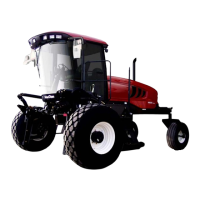
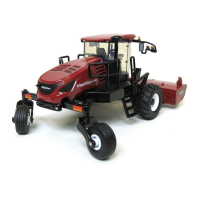
The provided document is an Operator's Manual for the MacDon Model 9000 Self-Propelled Windrower.
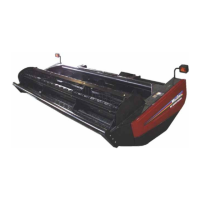
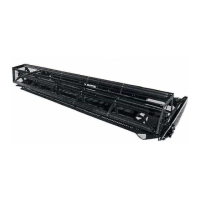
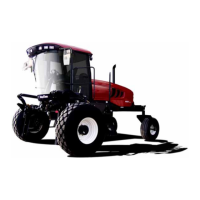
The MacDon Model 9000 Self-Propelled Windrower is designed for cutting and laying various grains, hay, and specialty crops in windrows. This process allows for earlier harvest, protects crops from wind damage, and offers greater flexibility in scheduling combine time. The power unit, referred to as the "tractor" in the manual, can be coupled with specially designed draper or auger headers.
Technical Specifications (Tractor):
- Wheel Base: 127.7" (3245 mm) or 112.8" (2865 mm)
- Height: 122" (3100 mm)
- Clearance Under Tractor: 38" (965 mm)
- Weight (varies with tire size):
- With gas engine: approx. 5955 lbs. (2700 kg)
- With naturally-aspirated diesel engine: approx. 6000 lbs. (2720 kg)
- With turbocharged diesel engine: approx. 6025 lbs. (2730 kg)
Transmission:
- Type: Hydrostatic
- Displacement: 2.48 cu.in. (40.6 cc)
- Final Drive Type: Planetary Gear Drive
- Final Drive Ratio: Gas: 24.53 to 1 / Diesel: 28.37 to 1
- Speed Range:
- Forward: Gas: 0 - 10 mph (16 km/h) / Diesel: 0 - 16 mph (26 km/h)
- Reverse: 0 - 6 mph (10 km/h)
- Mechanical: 4-A section belt, clutched drive
- Hydraulic: 2 circuits, clutch activated, with independent flow controls (0 - 8 US gpm each)
Cylinder Control Valve:
- Type: Open-center with 1, 2 or 4 sections
Electrical System:
- Battery Requirement: 12 Volt, Gas: minimum 560 CCA / Diesel: min. 640 CCA @ 0°F (-18°C)
- Alternator: 105 Amp
- Breakers: Lights (manual re-set) 50 Amp, Main (all functions except lights, manual re-set) 50 Amp, Air Conditioning and Header Controls 25 Amp, Instruments and Radio 6 Amp, Wiper, Interior Lights and Radio Memory 6 Amp, Screen Motor and Seat Switch 6 Amp
Air Conditioning:
- Cooling Capacity: 24,000 B.T.U./hour
- Compressor: 10 cu. in./rev., rotary
Park Brake:
- Type: Drum type, lever activated
Tires:
- Drive Tires (18.4 - 16.1 R1 Bar Type, 21.5L - 16.1 I3 Bar Type, 21.5L - 16.1 R3 Turf & Field): Normal Operating Pressure 18 to 20 psi (125 to 140 kPa), Tread Width 118.1" (3000 mm)
- Tail Wheel Tires (8.5L - 14 I1 Rib Implement, 9.5L - 14 I1 Rib Implement): Normal Operating Pressure 18 psi (125 kPa), Tread Width 115.0" (2920 mm) (all sizes)
- Tail Wheel Tires (16.5L - 16.1 I1 10 ply Rib): Normal Operating Pressure 4 psi (30 kPa)
Gas Engine:
- Type: Chrysler Industrial 90° V, 8 Cylinders
- Displacement: 318 cu.in. (5.21 L)
- Power: 85 hp (63 kW) @ 2300 rpm
- Oil Pressure: @ 2000 rpm 30 - 80 psi (210 - 550 kPa), @ minimum (idle rpm) 20 psi (140 kPa)
- Maximum (no load) Engine Speed: 2450 rpm
- Engine Idle Speed: 800 rpm
- Spark Plugs: RN 12 YC, Gap 0.035 in. (0.9 mm)
- Thermostat: 180°F (82°C)
Diesel Engines:
- Type: Cummins 4-390, 4 Cylinder, 4 stroke cycle - Naturally Aspirated or Turbocharged
- Displacement: 239 cu.in. (3.92 L)
- Power: Naturally Aspirated version 73 hp (54 kW) @ 2300 rpm, Turbocharged version 96 hp (71 kW) @ 2300 rpm
- Oil Pressure: @ 2300 rpm 30 to 60 psi (210 to 415 kPa), @ minimum (idle rpm) 13 psi (90 kPa)
- Maximum (no load) Engine Speed: 2450 rpm
- Engine Idle Speed: 800 rpm
- Thermostat: 180°F (82°C)
Usage Features:
The operator's station includes various controls and monitors.
- Ignition Switch: Three positions (OFF, RUN, START).
- Lights: A light switch with four positions (OFF, FLASHER, ROAD, FIELD) for different operating conditions. Turn signals are also available.
- Cab Temperature Controls: Blower speed switch (OFF, LOW, MEDIUM, HIGH), air conditioning temperature control, and heater temperature control. These systems are independent.
- Windshield Wiper Control: Manual park type.
- Windrower Controls:
- Variable Ground Speed Control Lever: Controls direction and speed. Features a neutral start switch and an operator presence system that stops the engine if the operator leaves the seat with controls not in neutral.
- Speed-Range Control (Diesel units only): Shifts transmission to FIELD or ROAD speed range.
- Throttle Lever: Increases/decreases engine speed (RPM).
- Park Brake Lever: Engages/releases the brake.
- Header Controls:
- Header Clutch Lever: Engages/disengages header drives.
- Conveyor Speed Control Switch: Increases/decreases conveyor speed (for drapers and double augers).
- Reel Speed Control Switch: Increases/decreases reel speed.
- Deck Shift Switch: Shifts decks left/right and reverses draper travel for center delivery.
- Reel Height Switch: Raises/lowers the reel.
- Header Height Switch: Raises/lowers the header.
- Cut Height Indicator: Gauge on the lift linkage to identify desired cut heights.
- Cut Height Switches: Controls left and right side cut height.
- Seat: Adjustable for operator weight, fore-aft position, height, seat-bottom angle, seat-back angle, and lumbar support. Armrests are also adjustable.
- Steering Wheel: Tilt adjustable.
Maintenance Features:
The manual provides detailed instructions for various maintenance procedures.
- Serial Number Locations: Important for ordering parts and service.
- Safety: Emphasizes reading manuals, following safety signs, wearing protective clothing, keeping hands/feet away from moving parts, stopping the engine before servicing, and maintaining a clean service area.
- Break-in Period: Specific checks and operating guidelines for the first 100 hours of operation for both the engine and windrower.
- Pre-Starting Checks (Annual & Daily): Comprehensive checklists including reviewing manuals, checking safety signs, ensuring shields are in place, familiarizing with controls, storing a first-aid kit and fire extinguisher, draining excess hydraulic oil, removing plastic bags/tape from openings, charging/installing battery, adjusting belt tension, checking for leaks, cleaning windows/mirrors, and performing annual/daily maintenance.
- Fuels, Fluids, and Lubricants: Specifications for diesel fuel, gasoline, engine coolant, grease, hydraulic oil, engine oil, bevel gear box lubricant, and power wheel gear lubricant. Includes instructions for storing lubricants and system capacities.
- Greasing: Detailed instructions and diagrams for greasing various points on the windrower tractor at specified intervals (50 hours).
- Engine (Gasoline & Diesel):
- Opening/Closing Side Panels: For engine compartment access.
- Lubricating Oil: Daily level checks, oil and filter change intervals (first 25 hours, then every 200 hours or annually), and draining/refilling procedures.
- Manifold Heat Control Valve (Gas): Lubrication every 100 hours.
- Closed Crankcase Ventilator Valve (Gas): Inspection every 100 hours, replacement every 500 hours.
- Governor Lubrication (Gas): Level check.
- Carburetor Storage (Gas): Draining for extended storage.
- Belts: Tension adjustment procedures.
- Spark Plugs (Gas): Inspection, cleaning, re-gapping, and replacement every 200 hours or annually.
- Ignition Timing Adjustment (Gas): Procedure for setting timing at 5° BTC @ 500 rpm.
- Distributor Air Gap Adjustment (Gas): Procedure for checking and adjusting gap to 0.006 inch (0.15 mm).
- Governor to Carburetor Linkage Adjustment (Gas): Procedure for adjusting throttle rod.
- Maximum Engine Speed Adjustment (Gas & Diesel): Procedures for setting engine speed to 2450 RPM.
- Governor Surge Adjustment (Gas): Procedure for adjusting bumper screw.
- Carburetor Idle Mixture Adjustment (Gas): Procedure for adjusting fuel/air mixture.
- Low Idle Adjustment (Gas & Diesel): Procedure for setting idle speed to 800 RPM.
- Valve Tappet Clearance (Gas & Diesel): Check and adjustment every 1000 hours.
- General Engine Inspection (Gas & Diesel): General service or tune-up every 2000 hours.
- Air Intake System (Gasoline & Diesel):
- Air Cleaner: Daily checks for proper functioning, cleaning elements with compressed air or washing, and inspection for damage.
- Filter Elements - Replacement: Primary element replacement after six cleanings or every three years; secondary element replacement every third time the primary is changed.
- Fuel System (Gasoline & Diesel):
- Storing Fuel: Guidelines for quality, cleanliness, and storage duration.
- Refuelling: Safety precautions and tank capacity.
- Fuel Tank Venting: Checking and changing the vent hose filter annually.
- Fuel Sediment Bowl: Daily inspection and cleaning.
- Fuel Filter (Gas): Cleaning every 500 hours.
- Fuel/Water Separator (Diesel): Daily draining.
- Fuel Filters (Diesel): Changing every 500 hours.
- Fuel System Air Removal (Diesel): Bleeding low pressure lines and fuel filters, and bleeding the Lucas-CAV injection pump (Naturally Aspirated Diesel).
- Engine Exhaust System: Muffler cleaning every 200 hours.
- Engine Cooling System:
- Coolant Level: Daily checks, recommendations for coolant type and concentration.
- Radiator Cap: Inspection for proper fit and condition.
- Anti-Freeze Concentration: Annual check.
- Changing Coolant: Procedure every 2 years.
- Screens and Coolers: Daily cleaning of radiator screen, oil cooler, and condenser.
- Electrical System:
- Battery: Safety warnings, charging procedures, booster battery usage, and maintenance (fluid level, charge, cleanliness, connections).
- Preventing Alternator and Regulator Damage: Guidelines for electrical connections.
- Lamps and Bulbs: Servicing and replacement of head/field lamps, flashing amber/red tail light bulbs, machine monitor light bulbs, dome light bulb, and turn signal indicators.
- Circuit Breakers: Checking in-cab and 50 amp circuit breakers.
- Two-Way Radio Installation: Instructions for wiring.
- Hydraulic System:
- Safety: Warnings about high-pressure fluids.
- Hydraulic Oil Cooler: Daily cleaning.
- Hydraulic Oil & Filter: Daily oil level checks, oil change every 2000 hours, and filter element change when indicated.
- Header & Reel Lift Hydraulic System: Cylinder control valve relief pressure check and adjustment.
- Header Drive Hydraulics: Flow control and relief pressure checks for Auger, Harvest, and Multi-Crop headers.
- Traction Drive: Hydraulics:
- Transmission Oil Pressure: Warning light and buzzer indications, and charge pump relief pressure check and adjustment.
- Neutral Lock Adjustment: Procedure to ensure starter engages only when controls are in neutral.
- Wheels and Tires: Annual lubricant level check for power wheels, wheel bolt torque checks (first 5 hours, then every 1000 hours), and tire inflation.
- Park Brake: Adjustment after the first 10 hours and every 100 hours thereafter.
- Cab Air System: Maintenance for fresh air intake filter and refrigerant charge.
- Trouble Shooting: Extensive tables for diagnosing and remedying common issues related to the cab air system, engine, electrical system, traction drive system, steering and ground speed controls, park brake, header hydraulics, and operator's seat.
- Unloading: Procedures for unloading the windrower using two forklifts or one forklift, including safety precautions and chain requirements.
- Assembly: Instructions for installing rear tires, drive tires, and battery, along with final adjustments and checks.
- Storage Procedure: End-of-season tasks including cleaning, storing in a dry place, removing/storing the battery, covering cutterbar/knife guards, covering the windrower if stored outside, blocking up to take weight off tires, repainting worn surfaces, lubricating, checking/repairing worn components, adding rust inhibitor to engine oil, spraying fogging oil into carburetor (gas engine), filling hydraulic oil reservoir, and testing engine coolant anti-freeze concentration.

 Need help?
 General

 To Next Page