6.0 BIV (BUILT-IN VERIFICATION)
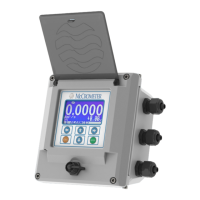
BIV, abbreviation of Built In Vericator, is available as option on the ProComm converter.
6.1 Functioning
The system test and store some functional parameters of sensor; the stored data shown any potential cause of sensor
failure. Every hour the system performs a number of measures on the sensor and records them in a le called “STESTLOG.
CSV”, residing in the root directory of the SD memory on converter. The analysis of the data collected is left to special
operating software on another device (PC, tablet, smart phone, etc.).
NOTICE: The sensor test can also be performed even with BIV o, but in this case it will be veried the overall functioning of
the sensor (coil resistance, current and excitation current rise times within the generic limits that guarantee the operation).
Instead, when BIV is active, the measures are more detailed and the measured values are tested by comparison with a set
of parameters of the sensor detected at the installation.
6.2 Saving Reference Values (Characteristic Parameters)
After the sensor installation the following steps should be follow to set the reference values:
[SCTRF] : Set the Reference Temperature and Saving it.
[SRFDS] : Saving characteristic parameters
Saving parameters will be possible after 500 samples of measure. If you try to save the reference values before 500 measures,
will be generated a specic error. (The time required is less than one minute). These functions are visible and active if the
BIV function and SD card have been enabled.
6.3 Criteria and Internal Limits Values
The measured data are compared with reference values. The measured deviation shall be within the preset values. Here
below the measured parameters:
• Temperature Coils (electrical resistance coils): compatible with the limits of the lining material;
• Current rise time: within % change in function of the resistance coils +10% (tolerance range)
• Electrical resistance between electrodes and common: 0.3< electrical resistance reference values>3.0
• Electrical leakage current (isolation test ): minus of 0.1 mA
If the values dier from these limits, it generates a coded alarm. The alarm remains active and visible on the display until
the next test (max. 1 hour).
NOTE: the insulation test is done with a test voltage of about 25-30V for all electronics.
6.4 General Notes for the Activation of BIV
To enable the periodic testing of the sensor and create its data les the function Sensor Verify (menu 1 sensor) or via the
MCP the function ASVFE = 1 shall be performed. This function can be activated even if the SD card and the BIV function is
not active at the hardware level. In this case the le will be NOT created and also any alarm will be generated. In practice, in
the absence of the necessary hardware/functions enabled, this function is useful to test the coils insulation.
30124-60 Rev. 1.0 | unreleased
Page 37
BIV (BUILT-IN VERIFICATION)
ProComm


 To Next Page