Need help?
Do you have a question about the Orban OPTIMOD 8400 and is the answer not in the manual?
The appliance should not be used near water, such as bathtubs, washbowls, or kitchens.
Ensure the appliance's location does not block ventilation openings.
Situating the appliance away from heat sources like radiators or stoves.
Connect the appliance only to the power supply type described or marked.
Take precautions to ensure the grounding or polarization means are not defeated.
Route power supply cords to prevent them from being walked on or pinched.
Clean the appliance only as recommended by the manufacturer.
Unplug the power cord when the appliance is left unused for a long period.
Take care to prevent objects from falling or liquids from spilling into the enclosure.
Details when the appliance requires servicing by qualified personnel.
User should not attempt service beyond operating instructions; refer to qualified personnel.
Safety instructions specific to European customers regarding appliance operation.
Important notice for UK customers regarding earthing and power cord wiring.
Instructions for verifying unit operation and initializing options on the bench.
Precautions to avoid reconditioning charges when returning a unit on trial.
Guidelines for packing the unit for shipping, including saving materials.
Guidance on troubleshooting installation or operation problems.
Overview of the OPTIMOD-FM 8400's capabilities and benefits for FM stereo broadcasting.
Describes the front panel controls and navigation system for easy setup and adjustment.
Details the 8400's transmitter protection and audio processing for FM broadcast.
Explains the various analog and digital input/output options and their configurations.
Discusses the two primary processing structures: Five-Band (Multiband) and Two-Band.
Outlines the various methods for controlling the 8400, including remote and PC interfaces.
Explains the two types of presets: Factory and User, and how they are managed.
Details the supported input and output configurations, including digital and analog.
Provides guidance on the optimal placement of the OPTIMOD-FM for system integration.
Explains different types of STLs and their requirements for audio transmission.
Advises on using lossy data reduction algorithms for media storage and supply.
Explains the differences in metering approaches for studio and transmission engineers.
Describes VU, PPM, and peak-sensing meters and their indications.
Covers calibrating equipment for consistent input/output levels and maintaining headroom.
Focuses on the transmission engineer's concern with peak levels to prevent transmitter overload.
Details how levels are metered on the 8400, including input and output levels.
Discusses the delay issues with processed audio and headphone monitoring.
Outlines methods for broadcasting EAS tones and data through the 8400.
Provides information on product warranty and customer feedback.
Step-by-step guide for installing the 8400 unit, including unpacking and checks.
Detailed description of the connectors and switches on the rear panel of the 8400.
Explains the cable and connector types for audio input and output.
Covers the digital input/output configuration, sample rates, and connectors.
Explains the composite outputs and subcarrier inputs, including level adjustments.
Discusses proper grounding techniques to prevent power faults and ground loops.
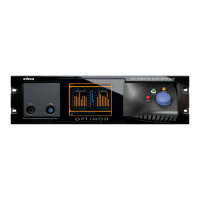
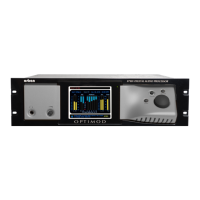
Describes the front panel controls, display, and indicators, including headphone jack.
Guides on installing an optional studio level controller, referencing other sections.
Provides a guided procedure for setting up the 8400 unit.
Configuration parameters for analog and digital inputs and outputs.
Instructions for setting up and using the system clock for automation events.
Information on setting up multi-level passcodes for system access control.
Details on using Serial Port #2 for security administration and preset recall.
Guides on programming the opto-isolated GPI remote control interface for various functions.
Information on setting up Ethernet networking for software upgrades and PC remote control.
Summary of the PC Remote software installation process from the included CD or download.
Describes the 8400/PD model, highlighting its blank front panel and remote control dependency.
Details the features and functionality of the optional HD ("High-Definition Digital Radio") upgrade.
Detailed description of the front panel controls, display, and indicators.
Provides an overview of audio processing concepts and their effects.
Discusses the 8400's signal processing innovations compared to its predecessor.
Introduces the flexibility of setup controls for tailoring the station's sound.
Discusses the two primary processing structures: Two-Band and Five-Band.
Introduces factory presets as starting points for sound customization.
Summarizes the equalization controls available for the Five-Band structure.
Explains the operation and controls of the stereo enhancer.
Details the Automatic Gain Control (AGC) settings common to Two-Band and Five-Band structures.
Describes the clipper controls common to Two-Band and Five-Band structures.
Describes the Two-Band structure, its characteristics, and protection presets.
Details the Five-Band structure's components and flexibility for on-air sound tuning.
Explains the ITU-R recommendation for limiting multiplex power and the 8400's controller.
Describes the available test modes: Operate, Bypass, and Tone.
Provides guidance on adjusting controls to achieve desired bass sound characteristics.
Instructions for using the PC Remote control software for managing presets and settings.
Recommended periodic checks for the OPTIMOD-FM Audio Processor's operation.
Detailed instructions for removing and replacing internal components and assemblies.
Procedures for conducting a performance audit, including required equipment.
Lists common problems and their potential solutions, starting with basic checks.
Troubleshooting steps if the headphone jack is not functioning correctly.
Addresses issues related to radio frequency interference, hum, clicks, or buzzes.
Troubleshooting steps for unexpectedly low on-air audio levels.
Addresses issues with inaccurate peak modulation control, often due to signal path problems.
Guidance on diagnosing audible distortion, checking source material and subjective adjustments.
Troubleshooting steps for audible noise, often caused by excessive compression.
Diagnosing whistles, likely caused by oscillation in analog circuitry or stereo decoders.
Troubleshooting interference from stereo signals into subcarriers, often related to exciter nonlinearity.
Addresses shrill or harsh sound issues, potentially caused by excessive HF boost or incorrect output settings.
Troubleshooting dull sound issues, often related to output settings or incorrect pre-emphasis.
Explains why sine waves may not reach 100% modulation due to processing.
Guidance on passing EAS tones, suggesting bypassing the 8400 or injecting them post-unit.
Troubleshooting digital output lock issues by verifying sample rate and mode settings.
Addresses 19 kHz frequency tolerance issues and suggests contacting customer service.
Troubleshooting stereo difference channel null issues, often caused by input phase shifts.
Discusses achieving satisfactory sound by adjusting presets and understanding trade-offs.
Refers to instructions for regaining access if the "All Screens" passcode is forgotten.
Troubleshooting common connection problems with PCs, modems, and networks.
Provides specific steps for diagnosing connection failures for Direct, Modem, and Network.
Provides OS-specific troubleshooting tips, particularly for Windows 2000 Direct Connect.
Guides on diagnosing and troubleshooting issues related to integrated circuit operational amplifiers.
Information on how to contact Orban customer service for technical assistance.
Recommendations for returning the product for factory service and warranty information.
Detailed instructions for packaging and shipping the unit for service.
Overview of the technical specifications for the 8400 unit.
Details the performance specifications, including frequency response and noise floor.
Provides specifications related to the analog audio input configuration and conversion.
Provides a detailed description of the 8400's circuits and their functions.
Gives a system overview, identifying circuit sections and their purposes.
Describes the microprocessor-based control circuit and its communication methods.
Explains the user interface components and how they interact with the LCD display.
Details the circuitry for interfacing analog and digital audio inputs to the DSP.
Describes the circuitry for interfacing the DSP to analog and digital audio outputs.
Explains the DSP circuit, consisting of Motorola DSP56362 chips for signal processing.
Details the power supply's function in converting AC voltage to various DC power sources.
A list of abbreviations used throughout the manual for technical reference.
Lists many of the parts used in the 8400, noting that few are field-replaceable.
Provides information on ordering exact replacement parts and avoiding substitutions.
Lists part numbers and component identifiers for the power supply section.
Lists parts and component identifiers for the Input/Output Circuit Board.
Lists parts and component identifiers for the Display Circuit Board.
Lists parts and component identifiers for the front panel assembly.
Lists parts and component identifiers for the Display Interface Circuit Board.
Lists parts and component identifiers for the Composite Input/Output Circuit Board.
Lists parts and component identifiers for the Control Circuit Board.
Lists the available schematics and assembly drawings for serviceable parts.
 General
| Brand | Orban |
|---|---|
| Model | OPTIMOD 8400 |
| Category | Computer Hardware |
| Language | English |

 To Next Page