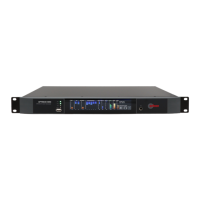
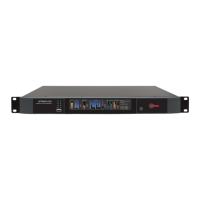
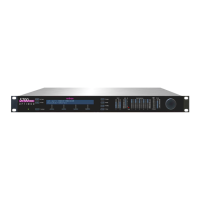
1-10
INTRODUCTION ORBAN Model 8400
Location of OPTIMOD-FM
Optimal Control of Peak Modulation Levels
The audio processing circuitry in OPTIMOD-FM produces a signal that is pre-
emphasized to either the 50μs or 75μs standard curve. It is precisely and absolutely high
frequency-controlled and peak-controlled to prevent over-modulation, and is filtered at
15 kHz to protect the 19 kHz pilot and prevent distortion caused by aliasing-related non-
linear crosstalk. If this signal is fed directly into a stereo encoder, peak modulation levels
on the air will be precisely controlled. However, if the audio processor’s signal is fed to
the stereo encoder through any circuitry with frequency response errors and/or non-
constant group delay, the peaks will be magnified. Peak modulation will increase, but
average modulation will not. The modulation level must therefore be reduced to accom-
modate the larger peaks. Reduced average modulation level will cause reduced loudness
and a poorer signal-to-noise ratio at the receiver.
Landline equalizers, transformers, and 15 kHz low-pass filters and pre-emphasis net-
works in stereo encoders typically introduce frequency response errors and non-constant
group delay. There are three criteria for preservation of peak levels through the audio sys-
tem:
1) The system group delay must be essentially constant throughout the frequency range
containing significant energy (30-15,000Hz). If low-pass filters are present, this may
require the use of delay equalization. The deviation from linear phase must not ex-
ceed ±10° from 30-15,000Hz.
2) The low-frequency −3 dB point of the system must be placed at 0.15Hz or lower (this
is not a misprint!). This is necessary to ensure less than 1% overshoot in a 50Hz
square wave and essentially constant group delay to 30Hz.
3) Any pre-emphasis used in the audio transmission system prior to the stereo encoder
must be canceled by a precisely complementary de-emphasis: Every pole and zero in
the pre-emphasis filter must be complemented by a zero and pole of identical com-
plex frequency in the de-emphasis network. An all-pole de-emphasis network (like
the classic series resistor feeding a grounded capacitor) is not appropriate.
In this example, the network could be fixed by adding a second resistor between ground
and the capacitor, which would introduce a zero.
Low-pass filters (including anti-aliasing filters in digital links), high-pass filters, trans-
formers, distribution amplifiers, and long transmission lines can all cause the above crite-
ria to be violated, and must be tested and qualified. It is clear that the above criteria for
optimal control of peak modulation levels are most easily met when the audio processor
directly feeds the stereo encoder. In the 8400, no circuit elements that might distort the
shape of the waveform are interposed between the audio processor and the stereo en-
coder. We therefore recommend using the 8400 with its built-in stereo encoder whenever
practical.


 To Next Page