1-6
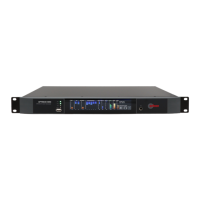
INTRODUCTION ORBAN Model 8400
Presets in OPTIMOD-FM
There are two distinct kinds of presets in OPTIMOD-FM: Factory Presets and User Pre-
sets.
Factory Presets
The Factory Presets are our “factory recommended settings” for various program formats
or types. The description indicates the processing structure and the type of processing.
Each Factory Preset on the Preset list is really a library of 20 separate presets, selected by
entering
Basic Modify and using the Less/More control to adjust OPTIMOD-FM for more
or less processing.
Factory Presets are stored in OPTIMOD-FM’s non-volatile memory and cannot be
erased. You can change the settings of a Factory Preset, but you must then store those
settings as a User Preset, which you are free to name as you wish. The Factory Preset re-
mains unchanged.
User Presets
User Presets permit you to change a Factory Preset to suit your requirements and then
store those changes.
You may store up to 64 User Presets. You may enter in any name you wish, up to 20
characters. The only exception is that you cannot name a User Preset the same as a Fac-
tory Preset, regardless of upper or lower case. (For example, if a Factory Preset is called
“Jazz,” you cannot have a User Preset called “jazz” or “JAZZ.”)
User Presets cannot be created from scratch. You must always start by recalling a Factory
Preset. You can then immediately store this in a User Preset, name it as you wish, and
then make changes to the settings. Alternatively, you can recall a Factory Preset, make
the changes, and then store this in a User Preset.
Either way, the Factory Preset remains for you to return to if you wish.
User Presets are stored in non-volatile memory that does not require battery backup.
Input/Output Configuration
OPTIMOD-FM is designed to simultaneously accommodate:
• Digital AES/EBU left/right inputs and outputs.
• Digital AES/EBU sync reference input.


 To Next Page