IG-150-EN version 04; 03/10/16
115
General instructions
ekor.rps
Automation functions
5.1.3. Setting range (6 tables)
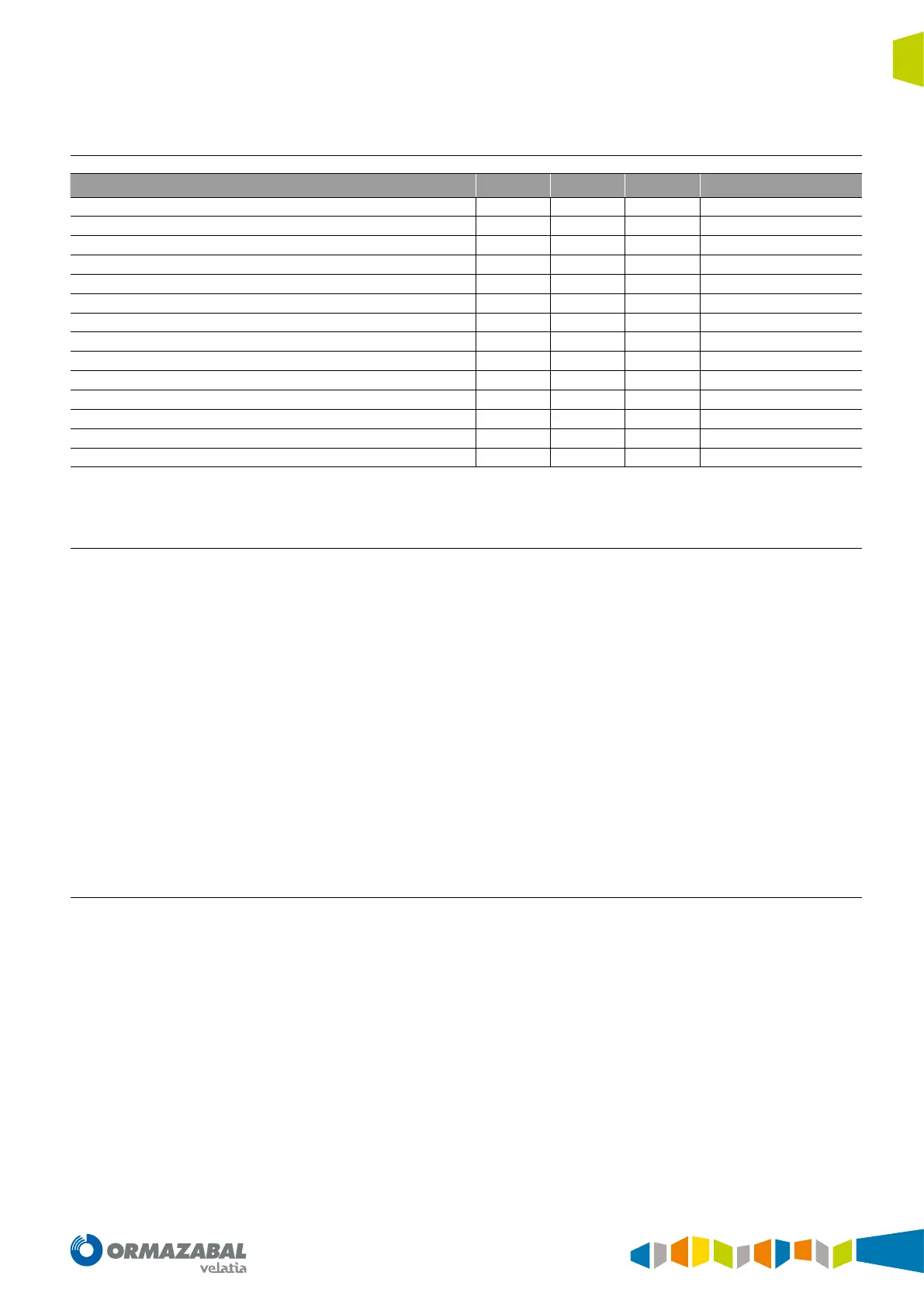
Setting Min Max Step Notes
Recloser in service
YES/NO
Number of closures
0 4 1
Waiting time for the rst closure, phase to phase faults [s]
0.05 600.0 0.01
Waiting time for the second closure, phase to phase faults [s]
1 600 1
Waiting time for the third closure, phases to phase faults [s]
1 600 1
Waiting time for the fourth closure, phase to phase faults [s]
1 600 1
Waiting time for the rst closure, phase to earth faults [s]
0.05 90.0 0.01
Waiting time for the second closure, phase to earth faults [s]
1 600 1
Waiting time for the third closure, phase to earth faults [s]
1 600 1
Waiting time for the fourth closure phase to earth faults [s]
1 600 1
Reclaim time after automatic closing, phase to phase faults [s]
1 600 1
Reclaim time after automatic closing phase to earth faults [s]
1 600 1
Reclaim time after manual closing [s]
1 600 1
Reference voltage waiting time [s]
1 600 1
Table 5.1. Setting range
5.1.4. Trips enabling (6 tables)
Through "YES" or "NO" it is programmed for each of the
possible tripping conditions:
1. Phase timed overcurrent
2. Neutral timed overcurrent
3. Phase instantaneous overcurrent
4. Neutral instantaneous overcurrent
5. Broken conductor and current unbalance
If it is enabled or not in each of the following circumstances:
1. Standby
2. After manual closing
3. After the rst reclosing
4. After the second reclosing
5. After the third reclosing
6. After the fourth reclosing
The trip disabling by this procedure is eective during the
corresponding reclaim time and with the condition that
the recloser is engaged.
If the enabling of "trip by external protection operation" is
programmed "NO", the recloser will not consider that input
during the reclaim time, and if a circuit breaker opening
occurs for this reason, and without a trip order by their
own protection, it is considered as a manual opening and
therefore it does not proceed to reclose.
5.1.5. Enable of reclosings (6 tables)
By using "YES" or "NO" it will be programmed for each of the
possible reclosings whether it is allowed or not after each
of the 7 possible causes of own trips seen in the previous
section, and the trip by external protection operation.
It may be the case that a trip command is given by several
units and the corresponding reclosing enabling criteria are
not coincident. In such situation the reclosing decision will
be taken internally, depending on the specications for the
rst trip (by order, not by time) analysed according to the
following order:
1. Phase timed overcurrent
2. Neutral timed overcurrent
3. Phase instantaneous overcurrent
4. Neutral instantaneous overcurrent
5. Broken conductor or unbalance
6. External protection actuation
If it is decided that that reclosing is not enabled, it will be
moved on to the next reclosing analysis, until an enabled
one is found or until denitive trip is reached.
To prevent the reclosing by a determined protection
unit, the reclosing blocking settings R1 to R4 must be
programmed to "NO" from the last wished reclosing.
For example if a reclosing is not wished after phase time
delayed trip, and the maximum number of programmed
reclosings is 1, all reclosings (R1 to R4) after that type of trip
must be programmed to "NO".


 To Next Page