
 Need help?
Do you have a question about the OXI ELECTRONIC INSTRUMENTS One and is the answer not in the manual?
Essential safety guidelines and warnings for using the OXI One.
Details on electrical, radio, mechanical, and connectivity aspects.
List of items included in the OXI One package.
Step-by-step guide to begin using the OXI One sequencer.
Information on checking and managing the device's battery.
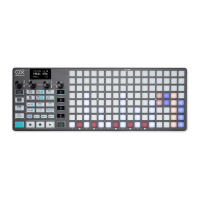
Explanation of the 128 RGB LED lit pads and their layout.
Description of information displayed on the screen and its layout.
How to configure global MIDI channel, mode, color, and more.
How encoders control parameters like Velocity, Octave, Gate, Mod, Tempo.
Functions for Play, Stop, Rec, and recording modes.
Features for previewing notes and navigating sequence pages.
How to store and retrieve projects, patterns, and song data.
Parameters like Grid Vertical Scroll, Playback Direction, Time Division.
Using the Expand function for sequence resolution.
Tools for creating variations using random parameters.
Generating sequences based on various parameters.
Specialized generator for rhythmic patterns in Multitrack mode.
Functionality for step editing and reducing sequence resolution.
Modulation, follow function, and global configuration options.
How the grid functions as a keyboard for playing notes and chords.
How to use the arpeggiator, its modes, and recording.
How to select sequencers, control signals, and route CV/Gate outputs.
Configuring pitch, velocity, and trig envelope routing for CV outputs.
Using LFOs and modulation lanes for parameter automation.
How the OXI One handles MIDI to CV and CV to MIDI transformations.
Using the arranger to link patterns and create songs.
Launching patterns in real-time for live performance.
Using encoders to send MIDI CC values to external devices.
Recording encoder movements for CC automation.
Global settings for Velocity, Octave, Gate, Mod, Swing, Scale, Root.
Using modulation lanes for per-step parameter changes.
Creating melodies, step entry, octave navigation, and transposition.
Editing parameters like Glide, Trig, Retrig, and Offset for mono steps.
Entering chords, transposing progressions, and editing step parameters.
Selecting chord types, voicings, and applying strum effects.
Using the grid as a keyboard for playing notes and chords.
Understanding tracks, mute/solo functions, and track randomization.
Editing individual tracks, applying randomization, and track parameters.
Track selection, playback direction, division randomization, and time division.
Editing velocity, gate, notes, modulation, and track glide.
Selecting tracks, arming tracks, and using keyboard for drum kits or synths.
Parameters for polyphonic notes like glide, probability, retrigger, velocity, gate.
Setting up chord sequencers as leaders and followers for harmonic sequences.
Common shortcuts for sequencer, encoders, and general operations.
Shortcuts for Piano Roll, Keyboard, Arranger, and CC Perform within sequencer modes.
How MIDI messages are routed and filtered between sequencers.
Using OXI One as a MIDI Bluetooth hub or peripheral.
Step-by-step guides for connecting via Bluetooth on different OS.
Comparison of Mono, Poly, Chord, and Multitrack modes.
Enabling OXI One to operate as a 128 GRID device using SHIFT.
Using the desktop/mobile app for firmware updates, backup, and configuration.
Step-by-step guide to calibrate CV outputs for accurate voltage.
Details on FCC and European directives, safety, and environmental issues.
Information on product disposal and environmental considerations.
Information on refund policy and what the hardware warranty covers.
 General
| Brand | OXI ELECTRONIC INSTRUMENTS |
|---|---|
| Model | One |
| Category | Recording Equipment |
| Language | English |

 To Next Page