EasyManua.ls Logo

PALAZZANI RAGNO XTJ 43 - User Manual

PALAZZANI RAGNO XTJ 43
191 pages
Print Icon
To Next Page IconTo Next Page
Loading...
PALIFT - DIVISION
RAGNO XTJ 43
USE AND MAINTENANCE MANUAL
RAGNO
SERIES NUMBER
YEAR OF PRODUCTION
MANUAL
XTJ 43 / C
PT 3582
2016
NM 665
Tel. 0039 030 6857073 - Fax 0039 030657079 info@palazzani.it - www.palazzani.it
Original copy

Table of Contents

Question and Answer IconNeed help?

Do you have a question about the PALAZZANI RAGNO XTJ 43 and is the answer not in the manual?

Summary

General Warnings for Users

Conformity of the Instructions

Organisation of the Manual

Warranty

1. General Characteristics

1.1. Introduction

Introduction to the 'Ragno' aerial access platform, highlighting its features for aerial work and difficult access.

1.2. Description

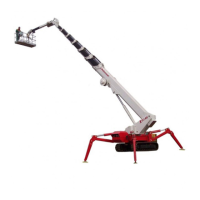
Detailed description of the 'Ragno' unit's main components, including frame, boom, cage, and power packs.

1.3. Directive and Rules

Information on CE directives and technical standards relevant to the machine's delivery and conformity.

1.4. Life Cycles

1.5. Dimensions and Performances

1.6. Dimensions

1.7. Working Area

1.8. Transport

1.9. Main Groups of the Platform

2. Safety Directions

2.1. General Safety Information

General safety instructions, user responsibilities, and the importance of understanding the manual.

2.2. Personnel Training

Requirements for operator training and qualification for using and maintaining the machine.

2.3. Destination to Use

Specifies the machine's design as an aerial work platform for personnel lifting.

2.4. Special Indications

Special operational instructions, including advice for sloping transfers and cold weather starts.

Operational Safety Alerts

Operational Safety Warnings

Critical warnings about leveling, structures, and safety devices before use.

Electrical Hazard Precautions

Precautions and dangers associated with working near overhead electric lines.

Cage and Load Safety Warnings

Safety rules for cage operation, handling tools, and managing wind exposure.

Wind Speed Safety Limits

Prohibitions and precautions related to wind speed limits during aerial work.

Improper Use and Modifications Warnings

Warnings against misuse, unauthorized modifications, and improper operation.

2.5. Improper Use

2.6. Use in Anomalous but Predictable Conditions

2.7. Use in Critical Conditions

2.8. Use Without Cage

2.9. Risks, Protections, Warnings, Cautions

2.9.1. Danger for the Operator

Identifies risks to the operator during normal functioning and potential hazards.

2.9.2. Residual Risks Generated by the Elements Under Pressure

Explains residual risks from pressurized hydraulic systems and elements.

2.9.3. Residual Risks During Maintenance

Details risks related to mechanical parts, falling objects during maintenance.

2.9.4. Explosive Atmosphere

Specifies limitations regarding operation in explosive or classified environments.

2.9.5. Slipping

Addresses the risk of slipping due to lubricant leaks and required precautions.

2.9.6. Stumbeling

Highlights tripping hazards from material storage and their impact on emergency exits.

2.9.7. Circuits Failure

Explains risks associated with circuit failures and the need for periodic checks.

2.9.8. Lightening

Details requirements for adequate lighting during maintenance and power failures.

2.9.9. Risk of Scalding;Burn

Addresses the risk of burns from engine temperatures during use and maintenance.

2.9.10. Risks Due to Movement

Details risks during lifting operations, including suspended loads and crush hazards.

2.9.11. Risks for the Exposed Persons

Considers risks to third parties not directly involved in machine operation.

2.10. Additional Warnings

2.11. Staff Protective Equipment

2.12. Environmental Conditions

2.12.1. Operating Environment

Defines acceptable environmental limits for temperature, humidity, altitude, and wind.

2.12.2. Conditions of Storage

Specifies environmental conditions for storing the machine when not in use.

3. Normal Work Conditions

3.1. Main Control Desk

Overview and identification of controls on the main control desk panel.

3.2. Ground Control Panel

Identification and function of controls on the ground control panel.

3.3. Cage Control Panel

Identification and function of controls located in the aerial cage.

3.4. Platform Starting Procedure

3.5. Use with Diesel Engine

3.6. Platform Working with Electric Motors

3.7. Platform Selfpropelling

3.8. Tracks Enlarging

3.9. Steering

3.10. Automatic Brake

3.11. Special Function Button FN

3.12. Levelling the Machine

Machine Leveling and Stabilization

Stabilization Precautions

Important notes on stabilizer placement, ground conditions, and slope limits for stability.

3.13. Aerial Work

Aerial Work Safety Procedures

Safety Belt and Boom Movement Rules

Mandatory safety belt use and rules for boom movements to prevent counterblow.

3.13. Working Area Automatic Limiting Device

3.14. Load Limiting Device

3.15. Cage Rotation

3.16. Automatic Cage Orientation

3.17. Electric Current Generator (Optional)

3.18. Intercom (Optional)

4. Emergency Conditions

4.1. Definition

Defines emergency conditions as personnel recovery due to illness or machine breakdown.

4.3. Persons Recovery from the Cage in Emergency

Procedure for recovering personnel from the cage in emergency situations.

Emergency Operation Safety

Electrical Hazard During Emergency Recovery

Critical warning about electrocution hazard if the platform contacts live lines during emergencies.

Emergency Procedures

2. Hydraulic Power

Describes using electric motor as an alternative power source during diesel engine breakdown.

3. Controls

Explains how to use controls from the ground panel for aerial work or emergency re-entry.

4. Emergency Stop

Explains the function of the emergency red push button and its self-retaining type.

5. Upper Controls Exclusion

Details the procedure for excluding upper controls in case of hydraulic hose breakage.

6. DC Pump for Emergency (Optional)

Recovery by Electro Pump

Recovery by Hand Pump

4.4. Stabilizers Recovery

4.5. Travelling

4.6. Quick Troubleshooting for the Operator

5. Maintenance and Check-up

Foreword

General recommendations for performing maintenance by qualified and authorized personnel.

5.1. Ordinary Maintenance - General Informations

General advice for correct maintenance to ensure long-life performance.

5.2. Hydraulic Oil Features

5.3. Daily Check

5.4. Weekly Check

5.5. Quarterly Check

5.7. Annual Maintenance

5.8. Four-Year Maintenance

5.9. Extraordinary Maintenance

Lubrication Scheme

5.10. Hydraulic Circuit Check

5.11. General Electric System and Battery Recharger Check

5.12. Chain Check

5.13. Safety Devices Check

Mechanical Check of Microswitches and Sensors

Procedures for mechanically checking microswitches and sensors for proper function.

Turntable Encoder

Checking the turntable encoder for secure connection, plays, and wear.

Boom Extension Sensor

Checking the boom extension sensor for tightness and connection integrity.

Electrical Check for Microswitches and Sensors

Procedure to check microswitches and sensors using the touch screen display.

Right Side Stabilizers Configuration Test (Fig. 5.21 - A)

Tests the microswitches detecting stabilizer positions on the right side of the machine.

Right Side Stabilizers Configuration Test (Fig. 5.21 - B)

Tests the microswitches detecting stabilizer positions on the left side of the machine.

Stabilizers Pins Test (Fig. 5.21 - C)

Tests the microswitches that detect the status of the stabilizers pins.

Chassis Inclinometer Test

Procedure to check the chassis inclinometer's accuracy against reference values.

Encoder Test

Procedure to check the turntable encoder values against reference.

Extension Sensor Test

Procedure to check the boom extension sensor readings.

Boom Inclinometer Check

Procedure to check the boom inclinometer's accuracy.

Basket Load Cell Check

Procedure to check the basket load cell's accuracy when empty.

6. Platform Assigment and Demolition

6.1. Assigment

Instructions for transferring machine ownership and responsibilities to a new buyer.

6.2. Demolition

General procedures and regulations for machine demolition and disposal.

6.2.1. Waste Material Disposal

Guidance on the disposal of waste materials like oils and filters, adhering to national regulations.

6.2.2. Indications for Special Waste

Information on special waste residues from industrial processes and machinery demolition.

Important Information for the User Under Directive “RAEE”

Special Waste Disposal Warnings

Warnings about improper disposal of products and manufacturer's responsibility for WEEE.

6.2.3. Demolition

Engine Replacement

Gears Replacement

Safety Devices Replacement

Periodical Check-up

Hydraulic Winch Application

A1 Dimensions

A2 Working Area

A3 Description and Use

A4 Fitting of the Winch

Winch Installation and Operation Safety

Pulley and Load Limiter Safety

Strict prohibition on using the winch without pulleys; ensures load limiter function.

A5. Use of the Winch

Winch Operation Safety Precautions

Vertical Pull Requirement for Winch Loads

Prohibits using the winch with oblique pulls, requiring vertical pull for safety.

Ragno XTJ 43

Versione Cingolata - Crawler Version - Execution sur Chenille

Specifies the machine's configuration as crawler version, emphasizing its track system.

Instructions for Ordering

TAV. 01 Chassis

TAV. 02 Turntable

TAV. 03 Stabilizzatore; Outrigger

TAV. 04 Carter; Crankcase

TAV. 05 Cilindro SfIlo Jib; Extension Cylinder Jib

TAV. 06 Cilindro Jib; Cylinder Jib

TAV. 07 Cilindro Sollevamento; Lift Cylinder

TAV. 08 Cilindro SfIlo Braccio; Extension Cylinder Boom

TAV. 09 Cilindro Stabilizzatori; Outrigger Cylinder

TAV. 10 Braccio Sollevamento; Lifting Boom

TAV. 11 1°a Prolunga; 1° Boom

TAV. 12 2°a Prolunga; 2° Boom

TAV. 13 3°a Prolunga; 3° Boom

TAV. 14 4°a Prolunga; 4° Boom

TAV. 15 5°a Prolunga; 5° Boom

TAV. 16 Braccio Jib; Boom Jib

TAV. 17 Prolunga Jib; Boom Jib

TAV. 18 Gruppo Cesto; Group Cage

PALAZZANI RAGNO XTJ 43 Specifications

General IconGeneral
BrandPALAZZANI
ModelRAGNO XTJ 43
CategoryBoom Lifts
LanguageEnglish