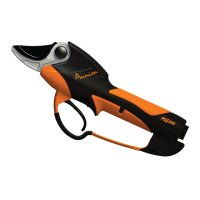
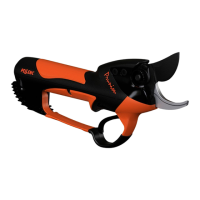
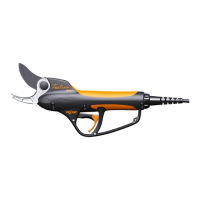
PRUNING SHEARS C45, C45-P150, C45-P200
163529-D
6. If operating a power tool in a damp location is unavoidable, use a residual current device (RCD) pro-
tected supply. Use of an RCD reduces the risk of electric shock.
2.2.3. PERSONAL SAFETY
1. Stay alert, watch what you are doing, and use common sense when operating the power tool. Do not
use a power tool when you are tired or under the influence of drugs, alcohol, or medication. A moment
of inattention when using a power tool can result in serious personal injury.
2. Use personal protective equipment. Always wear eye protection. Protective equipment such as dust mask,
non-skid safety shoes, hard hat, or hearing protection used for appropriate conditions will reduce personal
injuries.
3. Prevent unintentional starting. Make sure the switch is in the off position before you connect the tool
to the power source and/or battery pack, pick it up, or carry it. Carrying power tools with your finger on the
switch or plugging in power tools with the switch in the on position can cause accidents.
4. Remove any adjusting wrench before switching the electric tool on. A wrench or a key left attached to a
rotating part of the power tool may result in personal injury.
5. Do not overreach. Keep proper footing and balance at all times. This provides better control of the power
tool in unexpected situations.
6. Wear appropriate clothing. Do not wear loose clothing or jewelry. Keep your hair and clothing away
from moving parts. Loose clothes, jewellery or long hair can get caught in moving parts.
7. If devices are provided for connecting dust extraction and collection equipment, ensure that these are
connected and properly used. Use dust collectors to reduce the risk caused by dust.
8. Do not let familiarity gained from frequent use of tools allow you to become complacent and ignore tool
safety principles. A moment of inattention can result in serious personal injury.
2.2.4. USE AND CARE OF THE POWER TOOL
1. Do not force the power tool. Use the correct power tool for your application. The adapted power tool does
the work better and more safely at the speed it was built to operate at.
2. Do not use the power tool if the switch does not turn it on and off. Power tools that cannot be controlled
by a switch are dangerous and must be repaired.
3. Unplug the tool from the socket or remove the battery (if possible) before any adjustment, change of
accessory or storage. These preventive safety measures reduce the risk of accidentally starting the power
tool.
4. When not in use, keep power tools out of the reach of children and do not allow persons unfamiliar
with the power tool or these instructions to operate it. Power tools are dangerous when operated by inex-
perienced users.
5. Complying with the maintenance of the power tool and its accessories is mandatory. Check for mis-
alignment or binding of moving parts, breakage of parts and any other condition that may affect the
power tool’s operation. If damaged, have the power tool repaired before use. Many accidents are due to
poorly maintained power tools.
6. Keep the cutting elements sharp and clean. Properly maintained cutting tools with sharp cutting elements
are less likely to jam and are easier to control.
7. Use the power tool, accessories, blades, etc. in accordance with these instructions, taking into account
the working conditions and the work to be done. Using the power tool for operations other than those
specified can result in hazardous situations.
8. Handles and gripping surfaces must be kept dry, clean and free from oils and grease. Slippery handles
and grasping surfaces do not allow for safe handling and control of the tool in unexpected situations.
2.2.5. BATTERY TOOL USE AND CARE
1. Recharge only with the charger specified by the manufacturer. A charger that is suitable for a specific
battery pack may create a fire hazard when used with another type of battery pack.
2. Use power tools only with specifically designated battery packs. Use of any other battery pack may create
a risk of injury and fire.
3. When battery pack is not in use, keep it away from other metal objects, like paper clips, coins, keys,
nails, screws or other small metal objects, that can make a connection from one terminal to another. A
short-circuit between the battery terminals may cause burns or fire.
8


 To Next Page