Responding to Alarms
39
Responding to Alarms
Patient Alarm
A Patient Alarm indicates that the baby’s breathing or heart activity is outside the limits prescribed by the
physician. The information in this section can help you respond appropriately to patient alarms. Read this
section carefully. If you have any questions, please contact Respironics.
Testing the Alarm
Before you use the monitor, test to see if you can hear the alarm from different rooms while there is noise
in the house.
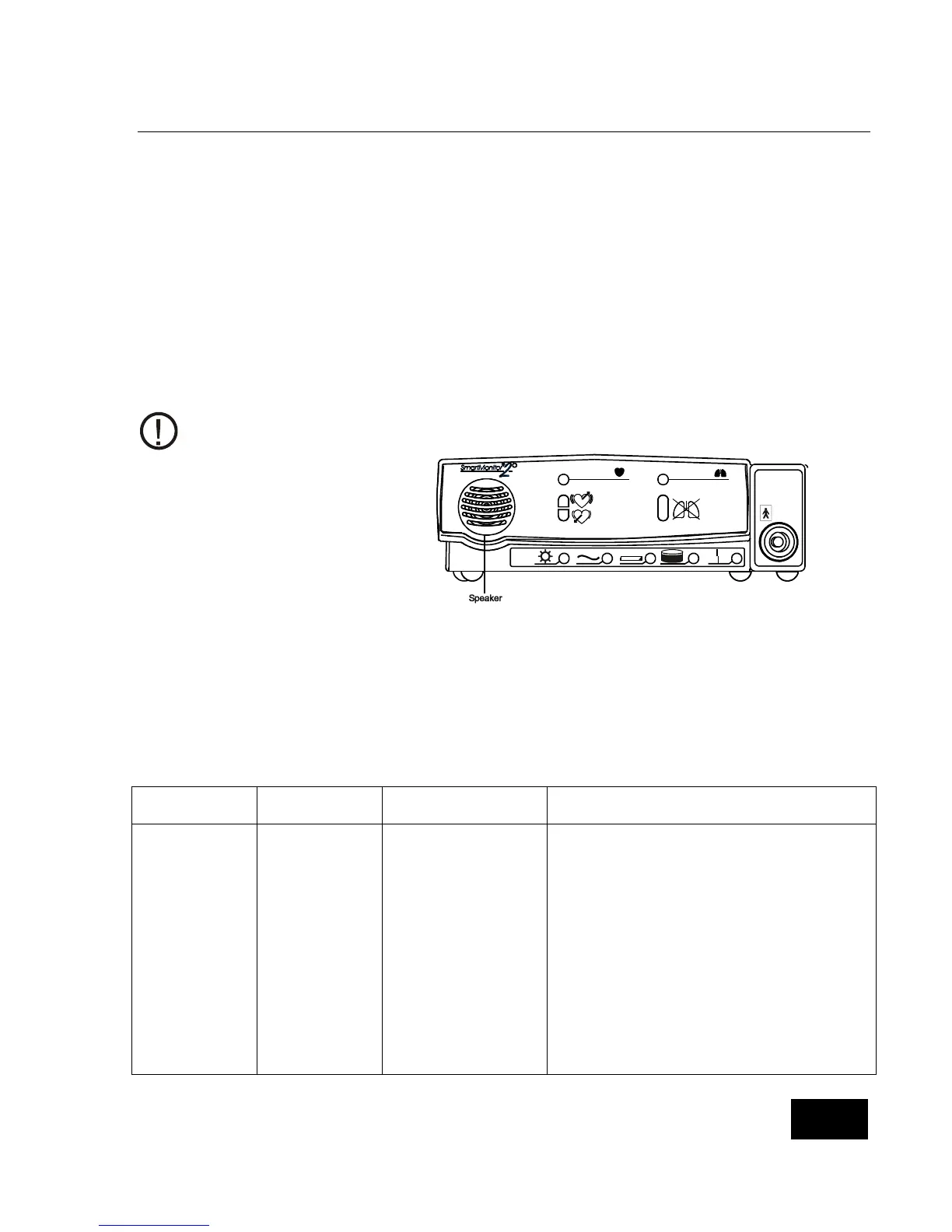
Caution: Be aware that the alarm sound is very loud.
Always keep the area in front of the
speaker clear.
Turn the monitor on (without the
baby attached) to sound the alarm.
Make sure you can hear the alarm
in different areas in the home.
If the alarm is not loud enough to
hear around the home, a Remote
Alarm may be required. This device
will allow you to hear the alarm from
a different room from where the
monitor is located.
If an Alarm Sounds
If an alarm sounds while the baby is being monitored, check the baby first. Then follow the instructions below to
respond to lights and alarms. Always check the baby’s skin color. Is it normal? Always check to see if the baby is
breathing. If the baby is not breathing, follow the “Respond Like this” instruction.
Light Alarm Check Baby's
Condition
Respond like this
Red Apnea
and/or Low
(Heart)
Intermittent
(1 beep/sec.)
Skin color is pale or
blue. Baby is not
breathing or is
choking.
Respond as instructed by the physician or in
your CPR class.
An example of your response could be as
follows:
Gently pat the baby. The baby may start
breathing and correct the cause of the
alarm on his/her own.
If the baby does not start breathing start
physical stimulation immediately.
If the baby starts breathing and corrects
the cause of the alarm, note it on your
log sheet.
Press the RESET button to reset any
alarm lights.



 To Next Page