− 90 −
ME12058B
Maintenance Section
APPENDIX 2
A2.1 Explanation of XRR (X-ray reflectometry method)
It is well known that the refractivity of materials against X-rays is slightly smaller than 1. Thus, if an
X-ray comes in at a very shallow angle, total reflection occurs.
In XRR, the intensity of a reflected X-ray is measured in an angle range close to that for total
reflection. At angles close to total reflection, the depth of X-ray invasion to materials is very shallow,
at 10 to 100 nm, and thus this configuration is used for analysis of the surface structure and thin-film
properties.
XRR can be adopted for either crystalline or non-crystalline materials, provided that the surface or
interface is smooth. In particular, XRR has attracted attention as a method capable of estimating the
thickness, density, and surface/interface roughness of thin films employed in semiconductor devices.
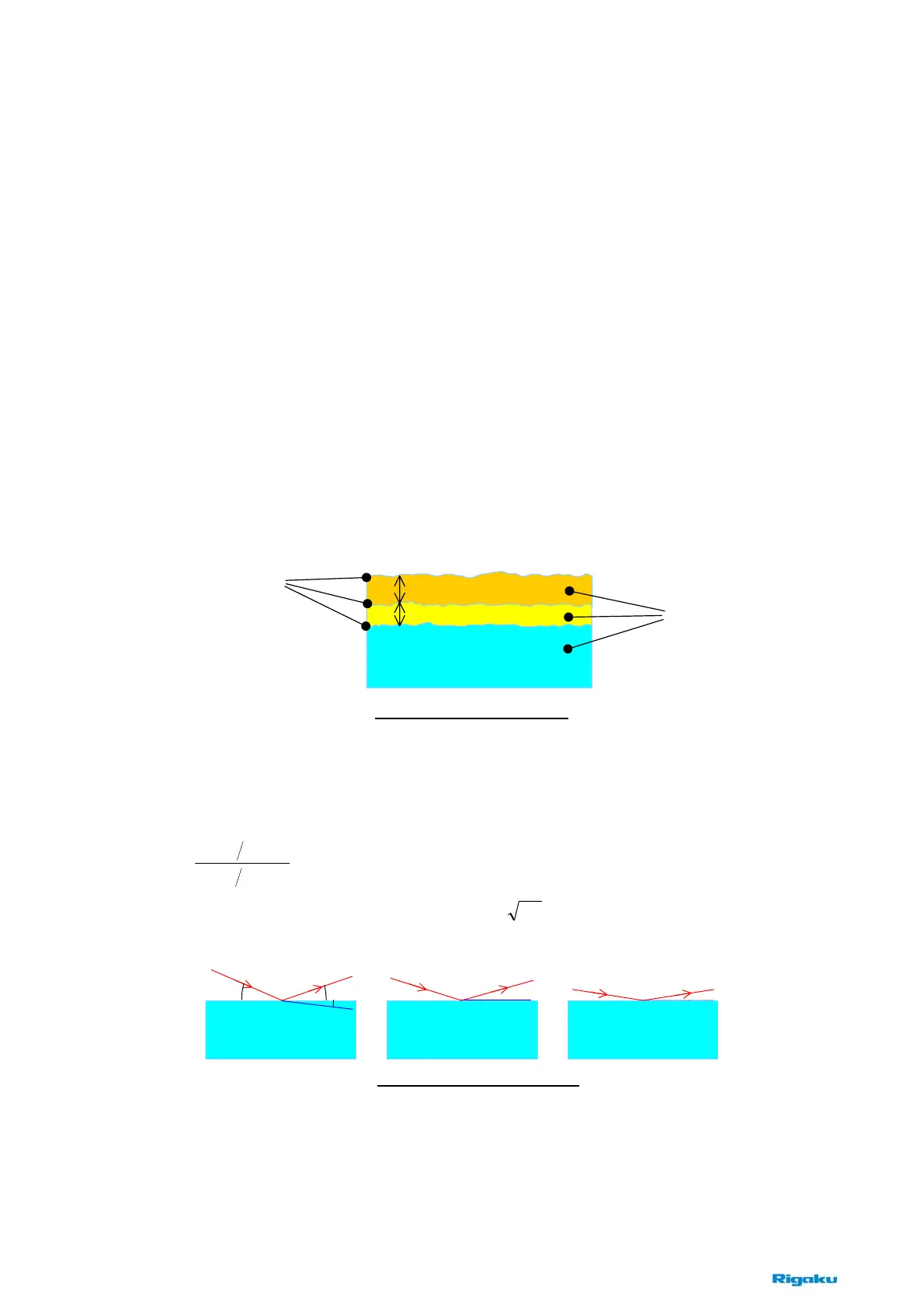
(1) Capable of estimating multi-layered films without destruction
(2) Capable of estimating film thickness in the range of a few tens to a few thousand Å
(3) Capable of estimating density if the composition of each layer is known
(4) Capable of estimating surface/interface roughness
Interface roughness
Film thickness
Film thickness
Density of each layer
(1) Total reflection of X-ray
Refractivity against X-ray
11 <−−=
in
Snell’s law
()
()
'2sin
2sin
θπ
−
−
=n
Total reflection occurs if
<' →
δθθ
2≅< c
θ
c
: Critical angle (2θ = 0.4 (Si..) to 1.0 degree (Ta..))
θ > θ
c
θ = θ
c
θ < θ
c
θ
θ
'
θ
Fig. A2-1-1 Layer Model
Fig. A2-1-2 Critical Angle



 To Next Page