7.6 Three-step control
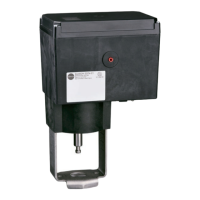
The flow temperature can be controlled using a PI algorithm. The valve reacts to pulses that
the controller emits upon an existing system deviation. The length of the first pulse, in particu
-
lar, depends on the extent of the system deviation and the selected
Proportional gain K
P
(the
pulse length increases as K
P
increases). The pulse and pause lengths change continuously un
-
til the system deviation has been eliminated. The pause length between the single pulses is
greatly influenced by the
Reset time T
N
(the pause length increases as T
N
increases).
The
Valve transit time T
Y
specifies the time required by the valve to travel through the range
of 0 to 100 %.
Functions
WE Configuration
Control type
three-step
1
2.0
120 s
45 s
CO1, 2, 4 -> F12 - 1, Rk_
K
P
(proportional gain) / 0.1 to 50.0
T
N
(reset time) / 1 to 999 sec
T
Y
(valve transit time) / 5, 10,15, …, 240 sec
7.7 On/off control
The flow temperature can be controlled, for example, by activating and deactivating a
boiler. The controller switches on the boiler when the flow temperature falls below the set
point by T = 0.5 x
hysteresis
. When the set point is exceeded by T = 0.5 x
hysteresis
, the
boiler is switched off again. The greater the value you choose for
Hysteresis
, the lower will
be the activation/deactivation frequency. By setting the
Minimum ON time
, an activated
boiler remains switched on during this period regardless of the flow temperature fluctuations.
Similarly, a deactivated boiler will remain switched off regardless of the flow temperature
fluctuations if the
Min. OFF time
has been specified.
Functions
WE Configuration
Control type
on/off
1
5 °C
2 min
2 min
CO1, 2, 4 -> F12 - 0
Hysteresis / 1 to 30 °C
Min. ON time / 0 to 10 min
Min. OFF time / 0 to 10 min
7.8 Releasing a control circuit over the binary input
The release of a control circuit using the binary output only becomes effective when the re
-
spective control circuit is in automatic operating mode (icon ). The released control circuit
always works in automatic mode; the deactivated control circuit behaves as if it were trans
-
ferred to stand-by mode.
EB 5575 EN 77
System-wide functions


 To Next Page