SATEL GSM-X 39
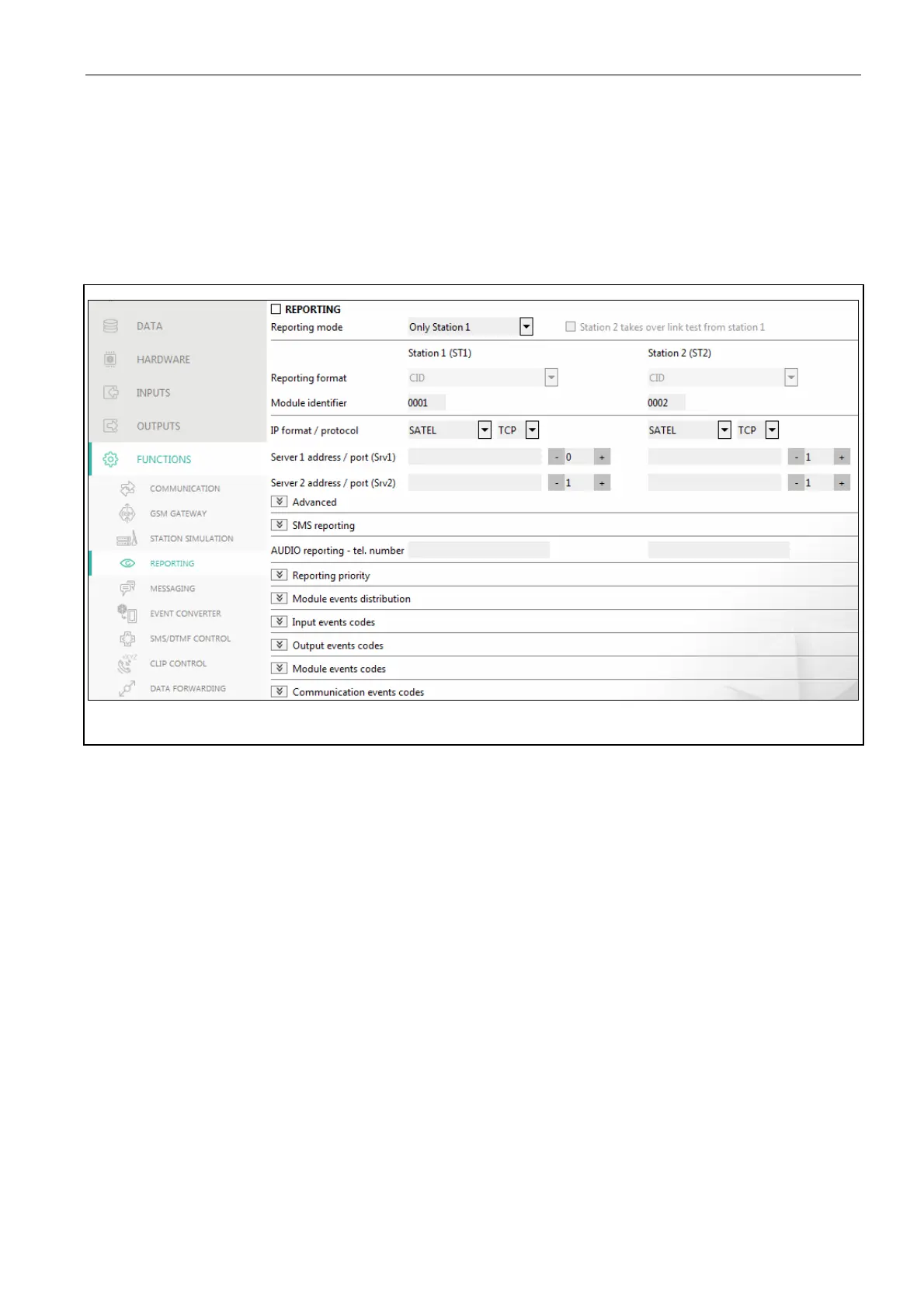
Station 1 and Station 2 – the event codes are sent to both stations (the module must
receive acknowledgement of the receipt of the code from both monitoring stations).
Station 1 or Station 2 – the module will make an attempt to send the event code to
station 1 and, if unsuccessful, to station 2.
Station 2 takes over link test from station 1 – if this option is enabled when the module
fails to connect to the monitoring station 1 during the connectivity test, the module will test
connectivity to the monitoring station 2. The option can be enabled if the SIA-IP format is
selected for both monitoring stations in the “IP format / protocol” field (see p. 39).
Fig. 35. “Reporting” tab.
Station 1 (ST1) / Station 2 (ST2)
Reporting format – information about the format in which event codes are sent to the
monitoring station. The reporting format can be defined in the “Station simulation” tab (see
“Reporting format” p. 37).
Module identifier – a string of characters that enables the monitoring station to define from
where the events are being sent. For the Contact ID format, it consists of 4 hexadec
imal
characters (digits or letters from A to F). For the SIA format, it consists of 6 hexadecimal
characters (digits or letters from A to F).
IP format / protocol – for reporting via GPRS or Ethernet, you must define:
format: SATEL or SIA-IP (SIA DC-09 standard).
protocol: TCP or UDP.
Server 1/2 address / port (Srv1)/(Srv2) – in the case of GPRS and Ethernet reporting,
enter:
address of the monitoring station. You can enter either the IP address or the domain
name.
number of the port used for communication between the module and the monitoring
station during reporting. You can enter a value from 0 to 65535.
AUDIO reporting – tel. number – phone number of the monitoring station for AUDIO
reporting (GSM voice channel).


 To Next Page