11
AMPLIFIER AND SPEAKER CONSIDERATIONS
This is an excellent time to think about your amplier and speaker system.
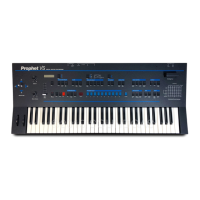
By converting the Prophet VS' electrical output into the potent vibrations you
hear, the sound system becomes part of the instrument. Of course you can
use anything you like or can aord. But obviously a synthesizer of this caliber
should not be constrained by a weak amplier and muddy speakers.
Consider the equipment to which you are going to connect the Prophet VS.
Does it give you adequate tone control? In addition to equalization, it is gener-
ally agreed that electronically-generated music is often enhanced by ambience
eects (since there is no natural resonance). If you don't already have one,
strongly consider getting a good digital delay line (DDL) or reverb. You won't
regret it.
For detailed, clear sound and to prevent clipping of the highly dynamic output
from the Prophet VS, extraordinary amounts of amplier headroom are need-
ed. It is not dicult to justify committing a stereo amp of at least 200 watts per
channel to a small-band performance. This may sound like a lot of power, but
keep in mind that a keyboard is generally required to produce cleaner sound
than a guitar, for example. As a practical matter, when the guitarist distorts, it
is expected. But when the synthesist distorts it usually attracts nasty looks.
Monitoring the Prophet VS in stereo is strongly recommended. While a mono
amp will suce, a stereo conguration will be able to take advantage of the
Prophet VS's separate left and right outputs, including the extensive voice
positioning and panning features, and will also be able to project the shifting
images created by the internal delay features and chorus, or by external delay
units or spatial modiers.
Speakers ought to be capable of handling the full amplier power over the full
audio range (20 Hz to 20 kHz) without distorting.
CAUTION! If it is not practical to use ampliers and speakers specically
designed for electronic instruments, or if volume must be kept low, using your
stereo system will generally give good high-frequency response. But if you
choose this method, be careful. Continuous playing of synthesizer sounds can
cause component ampliers to overheat. Furthermore, the dynamic range of
the Prophet VS places component speakers at some risk, because of power-
ful bass notes and transients which will damage them if the volume is set too
high.
HOME



 To Next Page