18
Modes
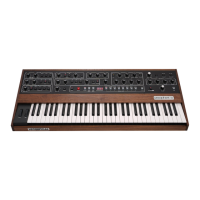
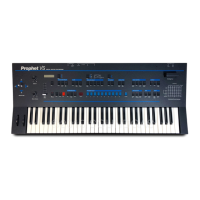
The Prophet VS is an eight-voice synthesizer. So, in Single mode you can play
and hear up to eight keys at once. In Split mode, you can play four keys on
either side, and in Double mode, you can play only four keys, but each key
simultaneously plays two programs. An exception to these normal conditions:
if Unison is on, only one key can be played at a time, but this key can play all
eight voices.
Percussion and eects programs sometimes use the keyboard primarily as
a triggering device. So it is possible that the keyboard will not be set up for
normal polyphonic playing at all.
Position
Of course the position of the key played determines the voice pitch. But it may
be less obvious that the key position is also used as a modulation source that
can control the oscillator mixture or voice pan position. (This is in addition to
its traditional control over lter cuto tracking.) The key position can have a
positive or negative inuence over these parameters (except for pitch). For
example, as you play ascending scales on the keyboard, the sounds produced
can move either from left to right, or from right to left in the stereo image.
Velocity
Velocity-sensitive analog processing allows the oscillator harmonic structure
to be intimately controlled by your keyboard technique. Be sure to try various
attack velocities (in other words, "key-down" speeds) in dierent areas of the
keyboard. The eect of velocity can change drastically. The graph on the front
panel shows the possible destinations for velocity. It can modulate the oscilla-
tor mixture, lter or amplier envelope depth, and the voice pan position within
the stereo eld (great for many eects).
Velocity modulation is called polyphonic, because up to eight dierent key ve-
locities can separately and independently modulate the eight individual voices.
Pressure
Like velocity, pressure is a modulation source which can be routed to >
any destination, and its eect, too, depends upon the selected program. The
graph on the front panel shows the destinations for pressure, which includes
individual oscillator frequencies, the oscillator mixture, lter cuto, LFO rate
and amount (modulation depth), amplier level, chorus rate and depth, or
voice pan position.
Pressure can be programmed to operate either positively or negatively (for
example, either raising or lowering the oscillator pitch). Pressure modulation is
called monophonic, because there is only one pressure signal from the key-
board, which provides the same control eect on all the voices that are being
played by the keys currently held.
Note: For more information on modulation, please see Section 10.
HOME



 To Next Page