30
SECTION 4
KEYBOARD MODES
SINGLE MODE
Normally the keyboard is a unied instrument (such as a piano), allowing you
to play up to eight keys at once. The keyboard normally operates in multi-
ple-trigger mode: pressing any key triggers a new envelope. If all eight voices
are being used, the most recently-played key generally "steals" the voice it
needs from the oldest note. For example, if you play and hold eight keys from
C to C, when you play the ninth key, the rst key that you pressed will disap-
pear.
If Unison/Detune is on, all eight voices are assigned to the last key played, for
a "fat" sound.
LINKING PROGRAMS
Often it is useful to be able to play two distinct sounds simultaneously (such
as brass and strings). To acomplish this, each current program has another
program "linked" to it. The linked program can either be 1) not heard at all: 2)
played from the lower octaves of the VS, with the current program played over
the higher octaves: or 3) played across the entire keyboard at the same time
as the main program. These three congurations —the "Keyboard Modes"—
are called "Single," "Split," and "Double."
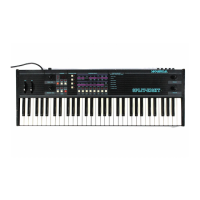
SPLIT MODE
Split mode divides the keyboard into left and right sections at a variable split
point (which is set as discussed below). The right section (from the split point
to the top C key) plays the current program. The left section (between bottom
C and the split point) plays the linked program. Split mode limits you to four
voices available for each side, unless Unison/Detune is on, in which case all
four voices on the side are assigned to the same key.
4
HOME



 To Next Page