47
can be selected for each oscillator. (This compares with three basic waveform
shapes available on a standard analog synthesizer.) Waveforms are selected
from either RAM (00-31) or ROM (32-127).
The importance of the waveforms is that the specic shape of the oscillator
wave, of course, determines its harmonic content, which in turn is perceived
as timbre. When two waveforms are combined, a new waveform is created,
which will have a timbre all of its own. In the Prophet VS, new timbres can be
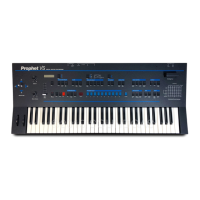
created by mixing up to four waveshapes together.
OSCILLATOR MIXER
Given four oscillators, what do you do with them? How do you control them
so that they are easy to set up, yet exible enough to allow new and complex
uses? For example, if you have just two oscillators, you can control the
mixture between them with one knob (as on the Prophet-600). But for three
or four oscillators, three or four level knobs are usually needed. Certainly,
requiring four knobs to adjust a timbre is cumbersome at best. Furthermore, if
you wanted to change the oscillator mixture dynamically (quickly, in real-time),
the traditional analog answer would require four envelope generators—for a
total of at least 20 interacting controls. While such synthesizer “patches” are
suitable for users of large, modular systems—who also happen to have a lot of
spare time—they are far too impractical for today’s performers.
And, it turns out, such complexity is unnecessary. To exploit the sonic
power of four oscillators, Sequential engineers turned to the basic concepts
of analytic geometry and found a very elegant solution in the Cartesian
coordinate system. By assigning an oscillator to each of the four poles,
a single point can simultaneously represent the mixture level for all four
oscillators. For example, if the mixture point is exactly in the center (at the
“origin”), you have an equal mixture of all four oscillators. Of course as the
mixture point moves away from center, the oscillator(s) towards which it heads
become louder and the oscillator(s) it moves away from get softer.
The basic way to move the oscillator mixer point is with the Waveform Mix
joystick. Please see Figure 6-3 (next page). One dimension of the mixer (the
“A-C axis”), is the blend of oscillators A and C, and the other dimension (“B-D
axis”) is the blend of oscillators B and D. The mixer values for each oscillator
are represented as percentages and always add up to 100%. So, when
the joystick is centered, each oscillator level is 23% of the overall mix. One
oscillator can have 100% of the mix.
HOME



 To Next Page