45
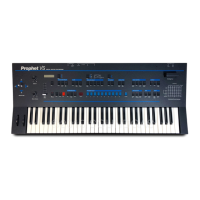
The oscillator mixture goes to the characteristic Prophet low-pass lter
which can shape the timbre in traditional analog fashion, as driven by its own
envelope generator. The voice dynamics are then shaped by the amplier,
which also has its own envelope generator. The output of the voice can
be sent to either the left or right audio output channel, along with that of
the seven other voices. The voice position within the stereo eld can be
modulated in a variety of ways.
The three envelope generators are far more exibile than the traditional ADSR
devices. And there are a number of other modulation sources, both physical
and electronic, which can further enliven the sound through a variety of
techniques.
The Prophet VS's modulation section has also been greatly enhanced by
the exibility which software allows. It provides over 40 dierent modulation
routings within the voice, but they are all easily controlled by just one source
switch and one destination switch.
With this overall view in mind, we can now look at the modules in more detail.
The manual sections correspond exactly to the front panel parameter groups.
OSCILLATOR BASICS
As mentioned in the general discussion, the origin of sound in the Prophet
VS voice are the four oscillators, named Oscillator A, B, C, and D. Using four
oscillators per voice provides a rich foundation as well as a broad selection
of basic timbres. All oscillators are completely independent: there is no
synchronization between them. And since there are eight voices, the Prophet
VS actually contains 32 oscillators in total.
The two most important attributes of an oscillator are its frequency and its
waveform. In the Prophet VS each oscillator actually has a number of sources
of frequency control.
HOME



 To Next Page