Levelogger Series User Guide
Page 65
10 Installation and Maintenance of Leveloggers
10.1 Installation
Many options exist for installation of the Levelogger, but essentially these installation methods can be classified
into two broad categories: free suspended or fixed installations.
1) In free suspended installations, the Levelogger is hung via suspension wire/cord or Direct Read Cable from a well
cap, or some fixed tie-off location, at the well head.
2) In fixed installations the Levelogger is fixed in place by a compression fitting, a clamping mechanism, simple
metal straps, etc.
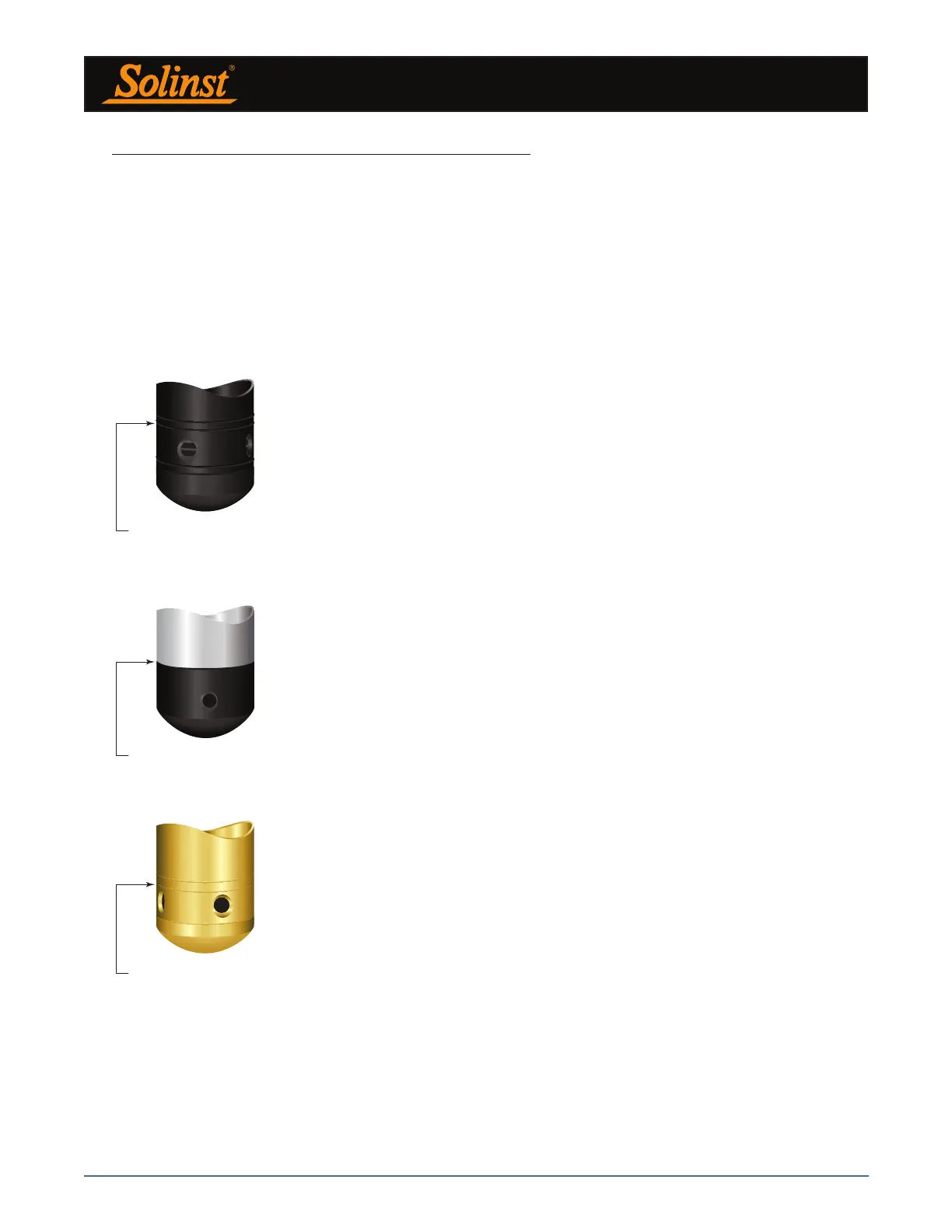
Figure 10-1
Levelogger 5 Junior/
Levelogger Junior Edge
/LTC Levelogger Junior
Measurement Line
Levelogger 5/
Levelogger 5 LTC/
Levelogger Edge/
LTC Levelogger Edge
Measurement Line
Levelogger Gold
Measurement Line
Most Leveloggers are installed in a vertical orientation. However, inclined or
horizontal installation is acceptable. The level sensor in the Levelogger is indicated
by the machined line around the body of the logger just above the pressure access
holes. The pressure transducer is oriented in a plane normal to the long axis of the
body and detects pressure directed along the plane of the long axis (Figure 10-1).
The sensor detects total pressure above the pressure transducer line.
Care should be taken to avoid dropping the Levelogger against a hard surface.
Leveloggers should always be installed with the installation cap on (if not using
a Direct Read Cable), whether it is being suspended by it or not. This prevents
unnecessary battery drainage and protects the optical eye(s).
Make sure you properly estimate the maximum and minimum expected water levels
during the monitoring period. You need to install your Levelogger so it remains
submerged at all times, and ensure that its maximum submergence depth
throughout the monitoring period remains within its specified range.
Note: When installing in a borehole, measure the total depth to ensure the Levelogger
does not touch the bottom (avoid submergence in sediment).
The pressure transducer can be damaged if the datalogger is over-pressurized
by submergence greater than its level range. The Levelogger 5, Levelogger 5
Junior, Levelogger 5 LTC, Levelogger Edge, Levelogger Junior Edge, and
LTC Levelogger Edge are warranted to pressures up to 200% of their full scale
level range (150% for the Levelogger Gold, Levelogger Junior and LTC Levelogger
Junior models), however accuracy can not be guaranteed beyond its full scale.
Other important considerations when installing the Levelogger in pressurized or
intermittently pressurized locations such as pressure vessels, pressurized pipes,
pulse flow conditions, drop structures or near hydraulics works, is to keep in mind
the potential effect of water or steam hammer and hydraulic jump. Water hammer
is caused by an abrupt alteration of flow direction resulting in pressure surges.
Steam hammer occurs when steam enters a cold pipe partially filled with water.
The hammer effect has the potential to significantly increase hydraulic pressure
possibly exposing the pressure sensor to pressures beyond its maximum rating.
Hydraulic jump is a phenomenon that occurs when water is ‘lifted’ or ‘ramped’
by velocity or flow obstructions. Hydraulic jump causes turbulence and creates
non-representative head conditions in the water column. Care should be taken to
avoid logger installation at points susceptible to hydraulic jump.


 To Next Page