When there is a Short Circuit in the Field
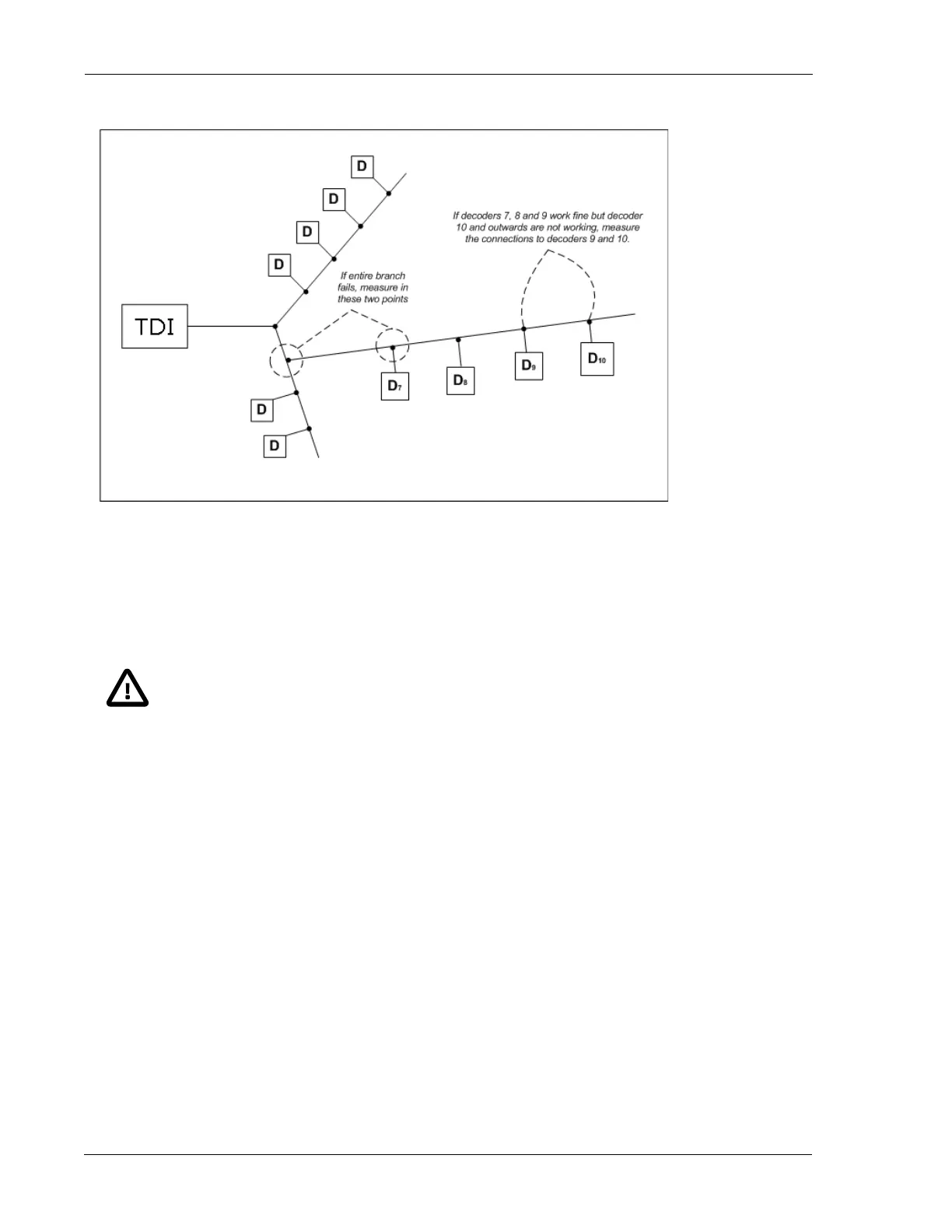
Figure 8.3. Checking a branch
If all connections seem OK, the two-wire itself might be damaged. Things to look for along the two-wire:
• Any signs of digging in the ground? Wild animals and staff under equal suspicion here.
• Has any other kind of machinery been at work and unknowingly penetrated the two-wire?
• Check all transitions where the cable runs from underground to over ground, from soil to pipes etc.
Important
If you replace a stretch of the two-wire, make sure to remove the old part completely
(disconnect all connections), as the old piece of cable might interfere with the current in the
new cable.
8.4.
When there is a Short Circuit in the Field
A "clean" short circuit in the field - direct connection between the two wires in the two-wire path with zero
Ohms resistance - will cause the Ranger Converter 3000 to display a warning. In addition to the warning,
you'll see that the Line Out LED is constantly lit instead of blinking as it normally does. If the short is very
severe the Line Out LED may stop working all together.
But you can't always be sure that the Ranger Converter 3000 will be able to detect a short circuit in the
field - if the short is in the far end of the cabling, the controller may just experience it as heavy usage.
However, the current reading will always reveal a short as the current will be significantly higher than normal.
(Could exceed the expected value with 100mA or more.)
Typically, a short circuit in the field is either a problem with the two-wire itself (cracks in the insulation, bad
connections etc.) or consequences of lightning striking the system, damaging stations, solenoids or other
electronics attached to the two-wire.


 To Next Page