2. When you locate the faulty branch, move on and perform a binary search. See next section.
Procedure 8.4. Phase III: Performing a "Binary Search" on a Faulty Branch
A binary search can help you locate a problem on the two-wire in a structured manner. The concept of a
binary search is this: Find a point on the cable where you know for sure current is running. Find another
point where there is little or no current. Now measure in the middle between these two points. If you measure
high current in the middle, you know for sure that there is no problem between the middle and the point
where you know current is running - the problem must be in the other half, and you can now repeat this
approach at the other half.
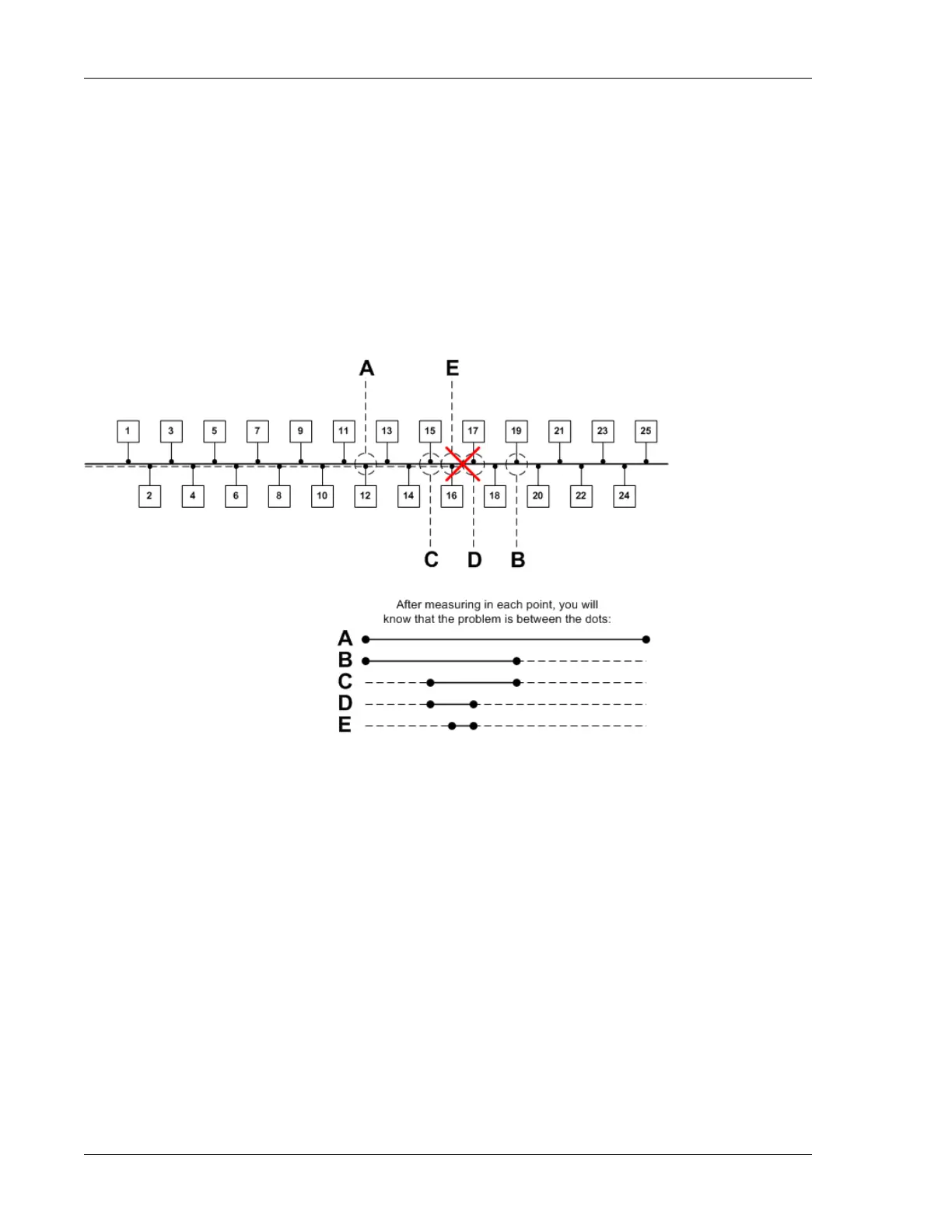
Looking at the graphic below we imagine that current is running at station 1 but no current is running at
station 25. To start the binary search we measure in the middle, at point A:
1. You measure in point A and find that the current is running. Now you know that the problem is somewhere
between station 12 and 25.
2. You measure in point B and find no current. This means that you're in the "dead" half of the cable - the
problem is somewhere between station 12 and 19.
3. You measure in point C and find that the current is running. The problem must be between station 15
and 19.
4. You find no current in point D - the problem is narrowed down to between station 15 and 17 - just one
more reading will tell you for sure where the problem is.
5. Since you find the current in E to be OK, the problem must be between station 16 and 17.
6. If you don't want to replace the entire cable between stations 16 and 17 (it might be a longer section,)
you can perform a new binary search on the cable itself.



 To Next Page