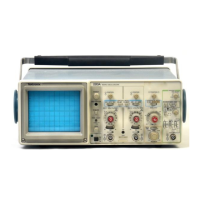
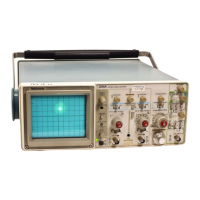
Maintenance-2445A/2455A
Service
9.
Use
a soldering iron that
is
connected to earth
ground.
1
O.
Use
only approved antistatic, vacuum-type
desoldering tools for component removal.
PREVENTIVE MAINTENANCE
INTRODUCTION
Preventive maintenance consists of cleaning, visual
inspection,
and
checking instrument performance.
When
accomplished regularly, it
may
prevent instrument malfunc-
tion
and
enhance instrument reliability.
The
severity of the
environment
in
which the instrument
is
used
determines
the required frequency of maintenance.
An
appropriate
time to accomplish preventive maintenance
is
just before
instrument adjustment.
GENERAL CARE
The
cabinet minimizes accumulation of dust inside the
instrument
and
should normally
be
in
place when operating
the instrument.
The
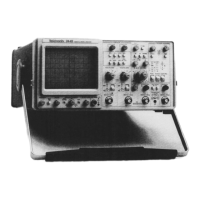
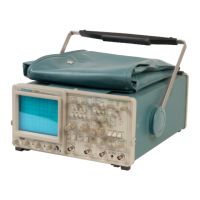
front cover supplied with the instru-
ment provides both dust
and
damage protection for the
front
panel
and
CRT,
and
it should
be
on
whenever the
instrument
is
stored or
is
being
transported.
INSPECTION AND CLEANING
The
instrument should
be
visually inspected
and
cleaned
as
often
as
operating conditions require. Accumu-
lation of dirt
in
the instrument
can
cause
overheating
and
component breakdown. Dirt
on
components acts
as
an
insulating blanket, preventing efficient heat dissipation. It
also provides
an
electrical conduction path that could
result
in
instrument failure, especially under high-humidity
conditions.
~
Avoid
the
use
of
chemical cleaning agents
which
might damage
the
plastics used in this instrument.
Use
a nonresidue-type
cleaner,
preferably isopropyl
alcohol
or
a solution
of
1 % mild detergent with 99%
water. Before using any other type
of
cleaner,
con-
sult your Tektronix Service Center
or
representative.
Exterior
INSPECTION. Inspect the external portions of the
instrument for
damage,
wear,
and
missing parts;
use
Table 6-2
as
a guide. Instruments that appear to
have
been
dropped or otherwise
abused
should
be
checked
thoroughly to verify correct operation
and
performance.
Deficiencies found that could cause personal injury or
could
lead
to further damage to the instrument should
be
repaired immediately.
Table 6-2
External Inspection Check List
Item Inspect For
Repair Action
Cabinet,
Lid,
Front
Panel
Cracks, scratches, deformations, damaged
Touch
up
paint scratches
and
replace
hardware or gaskets.
defective components.
Front-Panel Controls Missing, damaged, or loose knobs, buttons,
and
Repair or replace missing or defective items.
controls.
Connectors Broken shells, cracked insulation,
and
deformed
Replace
defective parts, Clear or wash out
contacts. Dirt
in
connectors.
dirt.
-
Carrying Handle Correct operation.
Replace
defective parts.
Accessories
Missing items or parts of items, bent pins, broken
Replace
damaged or missing items, frayed
or frayed cables,
and
damaged connectors.
cables,
and
defective parts.
6-2



 To Next Page