3 Identification and Construction
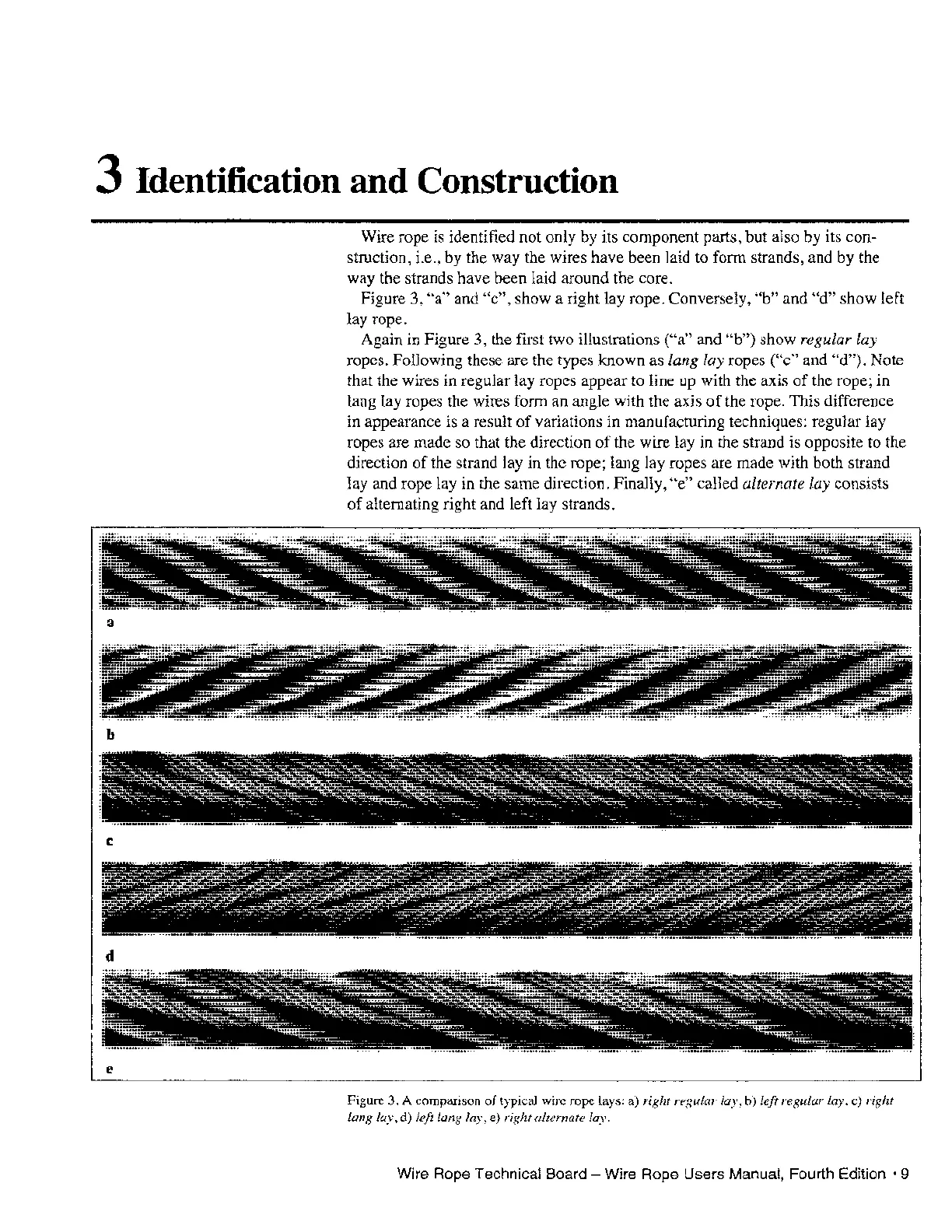
b
d
Wire rope
is
identified not only by its component parts, but also by its con-
struction, i.e., by the way the wires have been laid to form strands, and by the
way the strands have been laid around the core.
Figure 3,
"a" and
"c",
show a right lay rope. Conversely,
"b"
and
"d"
show left
lay rope.
Again in Figure 3, the first two illustrations
("a" and "b") show regular lay
ropes. Following these are the types known as lang lay ropes
("c" and "d"). Note
that the wires in regular lay ropes appear to line up with the axis
of
the rope; in
lang lay ropes the wires form an angle with the axis
of
the rope. This difference
in appearance is a result
of
variations
in
manufacturing techniques: regular lay
ropes are made so that the direction
of
the wire lay in the strand is opposite to the
direction
of
the strand lay in the rope; lang lay ropes are made with both strand
lay and rope lay in the same direction. Finally,
"e"
called alternate lay consists
of
alternating right and left lay strands.
Figure 3. A comparison
of
typical wire rope lays: a) right regular lay, b) left regular lay, c) right
lang lay,
d) left lang lay, e) right alternate lay.
Wire Rope Technical Board - Wire Rope Users Manual, Fourth
Edition'
9


 To Next Page