END
PREPARATIONS
For a number
of
applications-such
as tight openings in drums,
or
other com-
plicated reeving systems - there may
be
a need for making special end prepara-
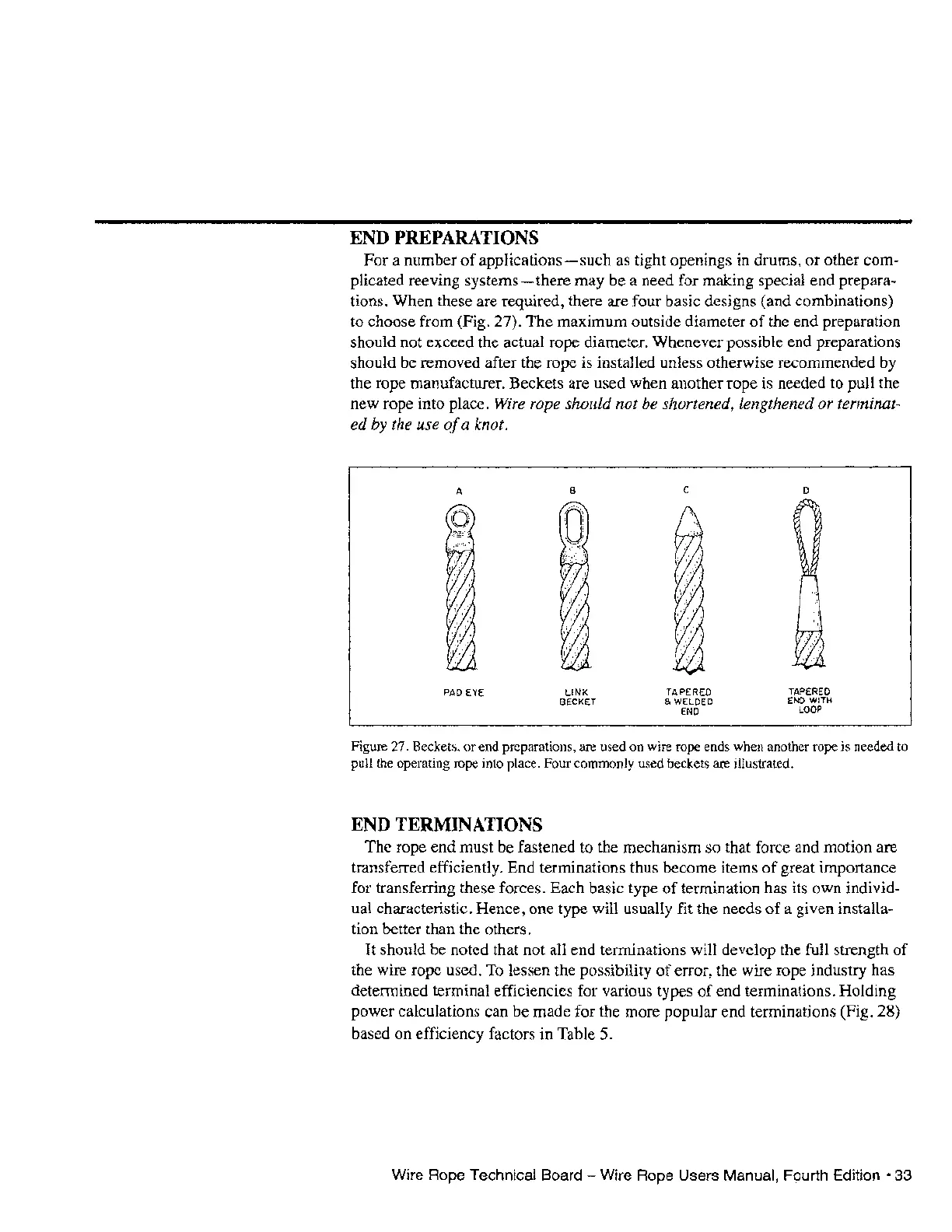
tions. When these are required, there are four basic designs (and combinations)
to choose from (Fig. 27). The maximum outside diameter
of
the end preparation
should not exceed the actual rope diameter. Whenever possible end preparations
should be removed after the rope is installed unless otherwise recommended by
the rope manufacturer. Beckets are used when another rope is needed to pull the
new rope into place. Wire rope should not be shortened, lengthened
or
terminat-
ed
by the use
of
a knot.
A
PAD
EYE
B
LINK
BECKET
c
TAPERED
SWELDED
END
o
TAPERED
END
WITH
LOOP
Figure 27. Beckets, or end preparations, are used on wire rope ends when another rope is needed to
pull the operating rope into place. Four commonly used beckets are illustrated.
END
TERMINATIONS
The rope end must be fastened to the mechanism so that force and motion are
transferred efficiently. End terminations thus become items
of
great importance
for transferring these forces. Each basic type
of
termination has its own individ-
ual characteristic. Hence, one type will usually fit the needs
of
a given installa-
tion better than the others.
It
should be noted that not all end terminations will develop the full strength
of
the wire rope used.
To
lessen the possibility
of
error, the wire rope industry has
determined terminal efficiencies for various types
of
end terminations. Holding
power calculations can be made for the more popular end terminations (Fig. 28)
based on efficiency factors in Table 5.
Wire Rope Technical Board - Wire Rope Users Manual, Fourth
Edition·
33



 To Next Page