Of
all the types
of
wire rope in current use, right regular lay (RRL) is found in
the widest range
of
applications. Nonetheless, in many equipment applications
right lang lay (RLL) or left lang lay (LLL) ropes are required. As for alternate
lay
(R-ALT or L-ALT) ropes, these are only used for special applications.
Compared to other types, the superiority
of
lang lay rope in certain applica-
tions derives from the fact that when bent over sheaves, its life span is longer
than the others. Stated in another way, the advantage
oflang
lay rope is its
greater fatigue resistance.
Yet
another claim
is
made for lang lay ropes: they are
more resistant to abrasion.
It
is important to understand the reasons for the advantages
of
lang lay rope.
To
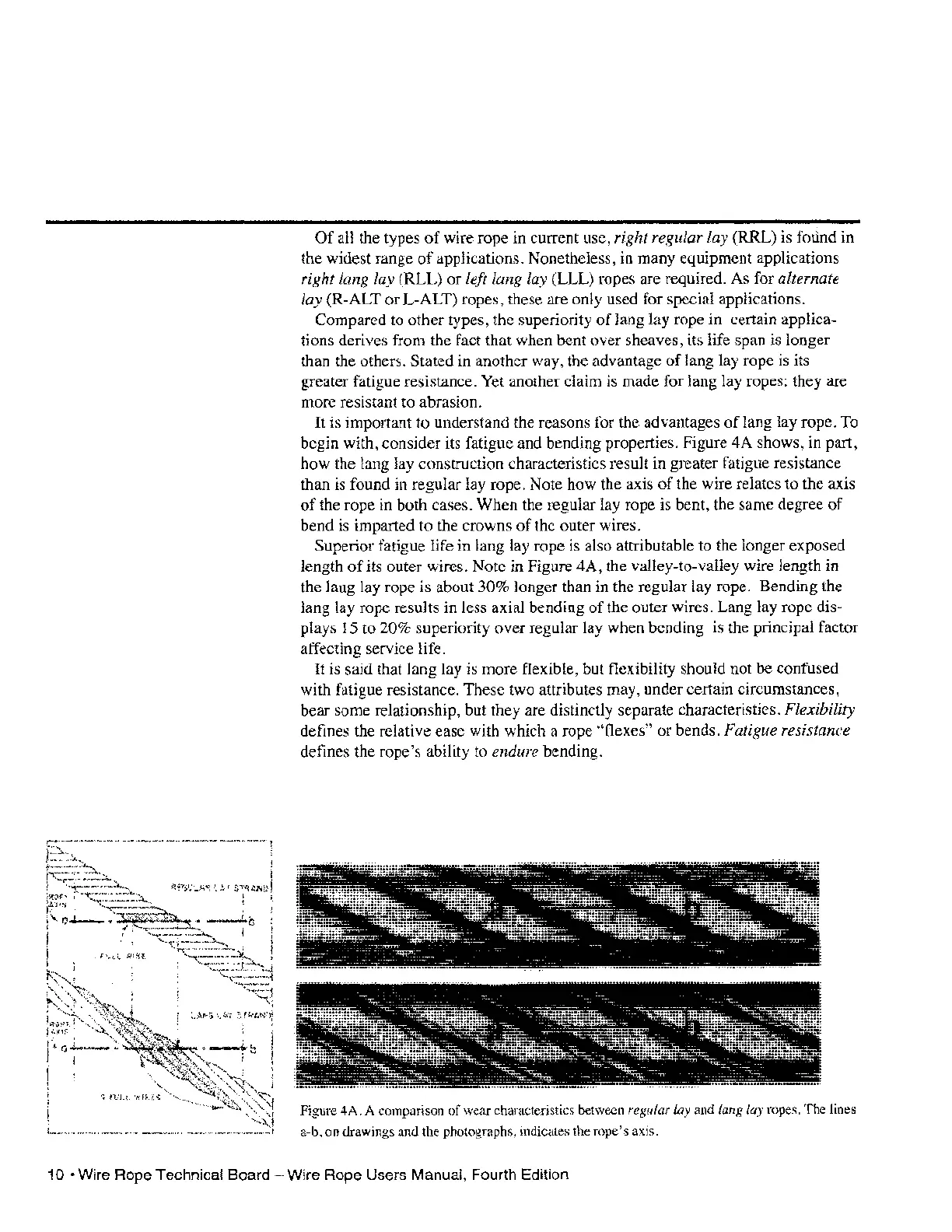
begin with, consider its fatigue and bending properties. Figure 4A shows, in part,
how the lang lay construction characteristics result in greater fatigue resistance
than is found in regular lay rope. Note how the axis
of
the wire relates to the axis
of
the rope in both cases. When the regular lay rope is bent, the same degree
of
bend is imparted to the crowns
of
the outer wires.
Superior fatigue life in lang lay rope
is
also attributable to the longer exposed
length
of
its outer wires. Note in Figure 4A, the valley-to-valley wire length in
the lang lay rope is about
30% longer than in the regular lay rope. Bending the
lang lay rope results in less axial bending
of
the outer wires. Lang lay rope dis-
plays
15
to 20% superiority over regular lay when bending is the principal factor
affecting service life.
It
is said that lang lay is more flexible, but flexibility should not be confused
with fatigue resistance. These two attributes may, under certain circumstances,
bear some relationship, but they are distinctly separate characteristics.
Flexibility
defines the relative ease with which a rope "flexes" or bends. Fatigue resistance
defines the rope's ability to endure bending.
Figure 4A. A comparison
of
wear characteristics between regular lay and lang lay ropes. The lines
a-b, on drawings and the photographs, indicates the rope's axis.
10'
Wire Rope Technical Board - Wire Rope Users Manual, Fourth Edition


 To Next Page