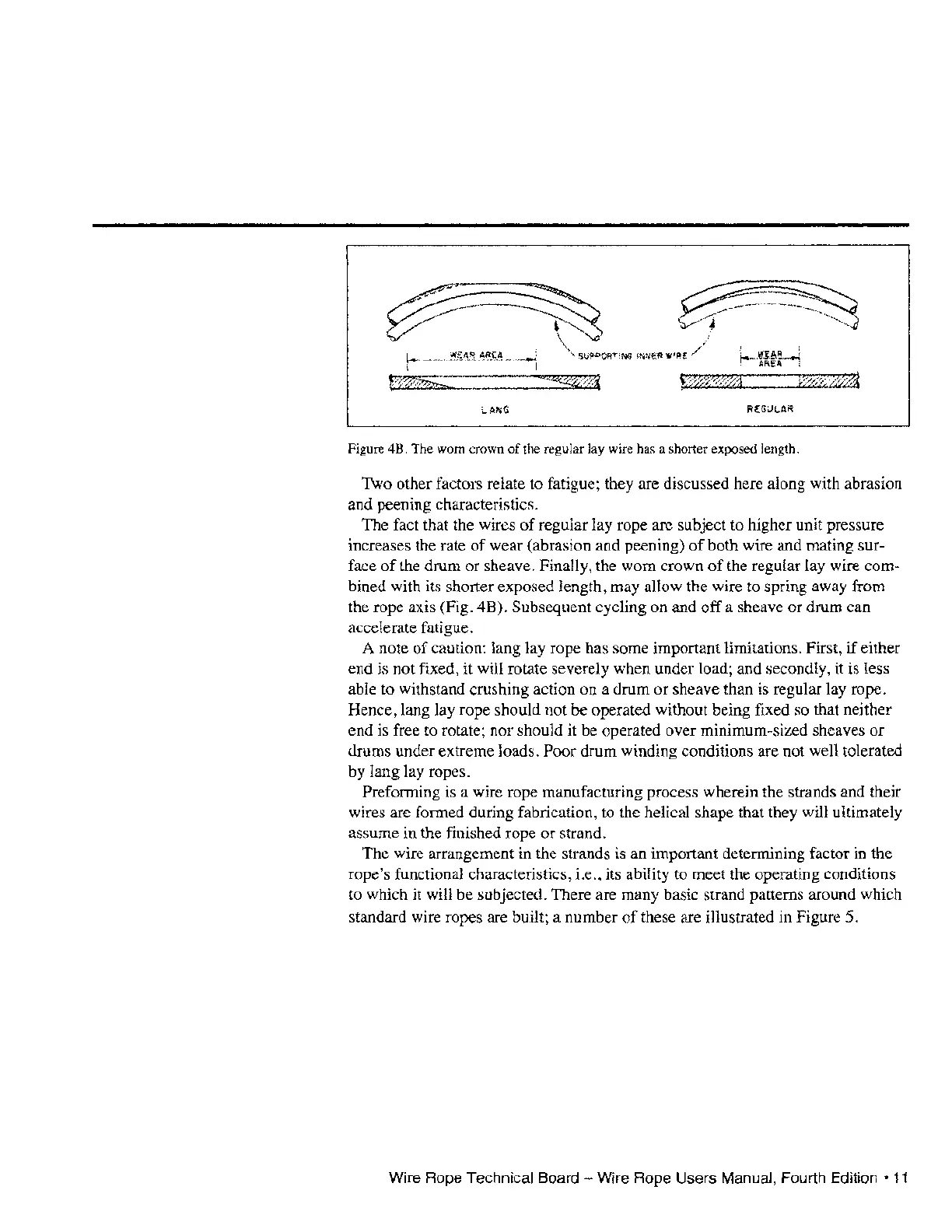
Figure 4B. The worn crown
of
the regular lay wire has a shorter exposed length.
Two other factors relate to fatigue; they are discussed here along with abrasion
and peening characteristics.
The fact that the wires
of
regular lay rope are subject to higher unit pressure
increases the rate
of
wear (abrasion and peening)
of
both wire and mating sur-
face
of
the drum or sheave. Finally, the worn crown
of
the regular lay wire com-
bined with its shorter exposed length, may allow the wire to spring away from
the rope axis (Fig. 4B). Subsequent cycling on and off a sheave or drum can
accelerate fatigue.
A note
of
caution: lang lay rope has some important limitations. First,
if
either
end is not fixed, it will rotate severely when under load; and secondly, it is less
able to withstand crushing action on a drum or sheave than is regular lay rope.
Hence, lang lay rope should not be operated without being fixed so that neither
end is free to rotate; nor should it be operated over minimum-sized sheaves
or
drums under extreme loads. Poor drum winding conditions are not well tolerated
by lang lay ropes.
Preforming is a wire rope manufacturing process wherein the strands and their
wires are formed during fabrication, to the helical shape that they will ultimately
assume in the finished rope or strand.
The wire arrangement in the strands is an important determining factor in the
rope's functional characteristics, i.e., its ability to meet the operating conditions
to which
it
will be subjected. There are many basic strand patterns around which
standard wire ropes are built; a number
of
these are illustrated in Figure 5.
Wire Rope Technical Board - Wire Rope Users Manual, Fourth Edition ·11


 To Next Page