A -
CORRECT
REEL
~
B-
WRONG
Figure 21. The correct (a) and the
wrong (b) way to wind wire rope
from reel to drum.
Figure 22. Perhaps the most common and
easiest uncoiling method is to hold one end
of
the rope while the coil is rolled along
the ground.
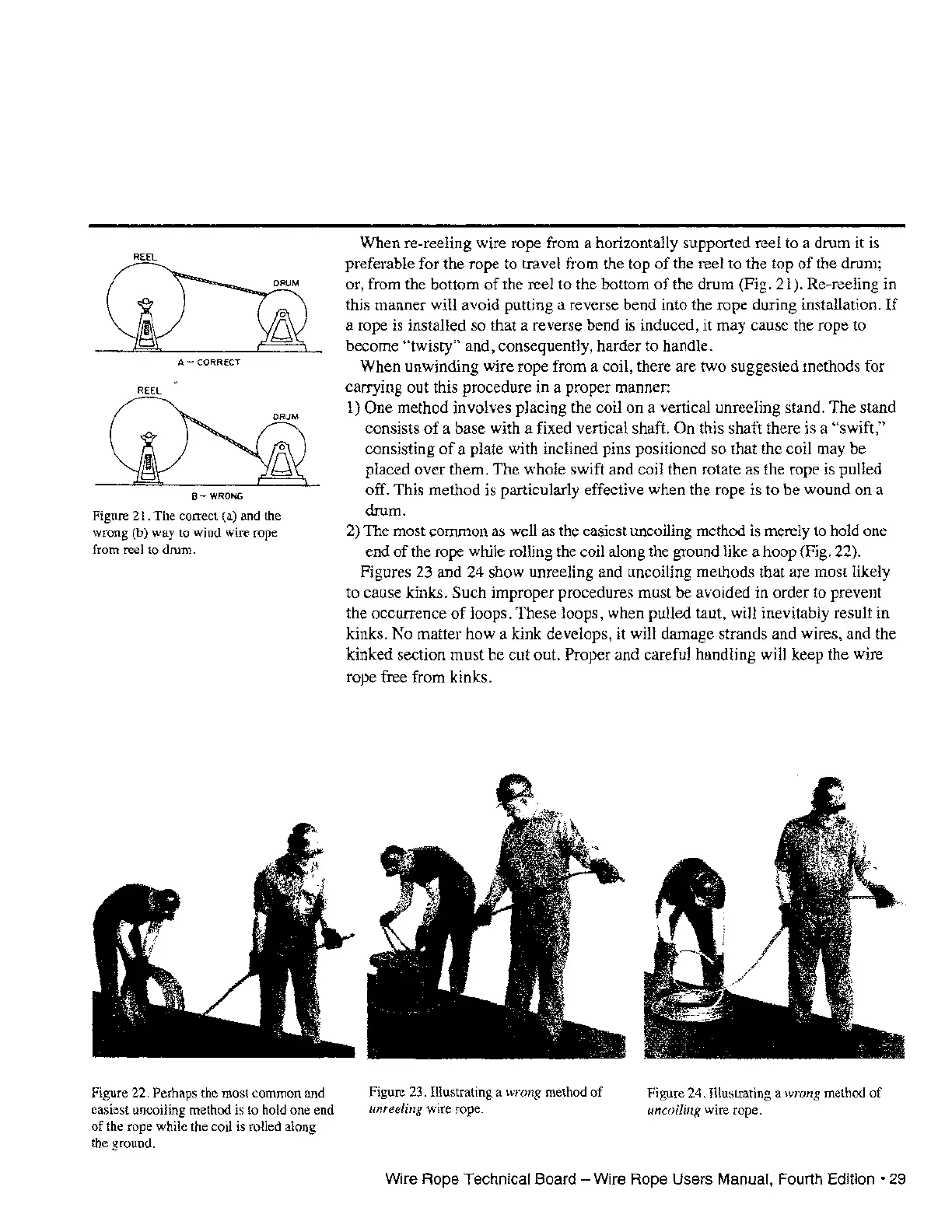
When re-reeling wire rope from a horizontally supported reel to a drum it is
preferable for the rope to travel from the top
of
the reel to the top
of
the drum;
or, from the bottom
of
the reel to the bottom
of
the drum (Fig. 21). Re-reeling in
this manner will avoid putting a reverse bend into the rope during installation.
If
a rope is installed so that a reverse bend is induced, it may cause the rope to
become
"twisty" and, consequently, harder to handle.
When unwinding wire rope from a coil, there are two suggested methods for
carrying out this procedure in a proper manner:
1) One method involves placing the coil on a vertical unreeling stand. The stand
consists
of
a base with a fixed vertical shaft. On this shaft there is a "swift,"
consisting
of
a plate with inclined pins positioned so that the coil may be
placed over them. The whole swift and coil then rotate as the rope is pulled
off. This method is particularly effective when the rope is to be wound on a
drum.
2)
The most common
as
well as the easiest uncoiling method is merely to hold one
end
of
the rope while rolling the coil along the ground like a hoop (Fig. 22).
Figures 23 and 24 show unreeling and uncoiling methods that are most likely
to cause kinks.
Such improper procedures must be avoided in order to prevent
the occurrence
of
loops. These loops, when pulled taut, will inevitably result in
kinks. No matter how a kink develops, it will damage strands and wires, and the
kinked section must be cut out.
Proper and careful handling will keep the wire
rope free from kinks.
Figure 23. Illustrating a wrong method
of
unreeling wire rope.
Figure 24. Illustrating a
wrong method
of
uncoiling wire rope.
Wire Rope Technical Board - Wire Rope Users Manual, Fourth
Edition·
29


 To Next Page