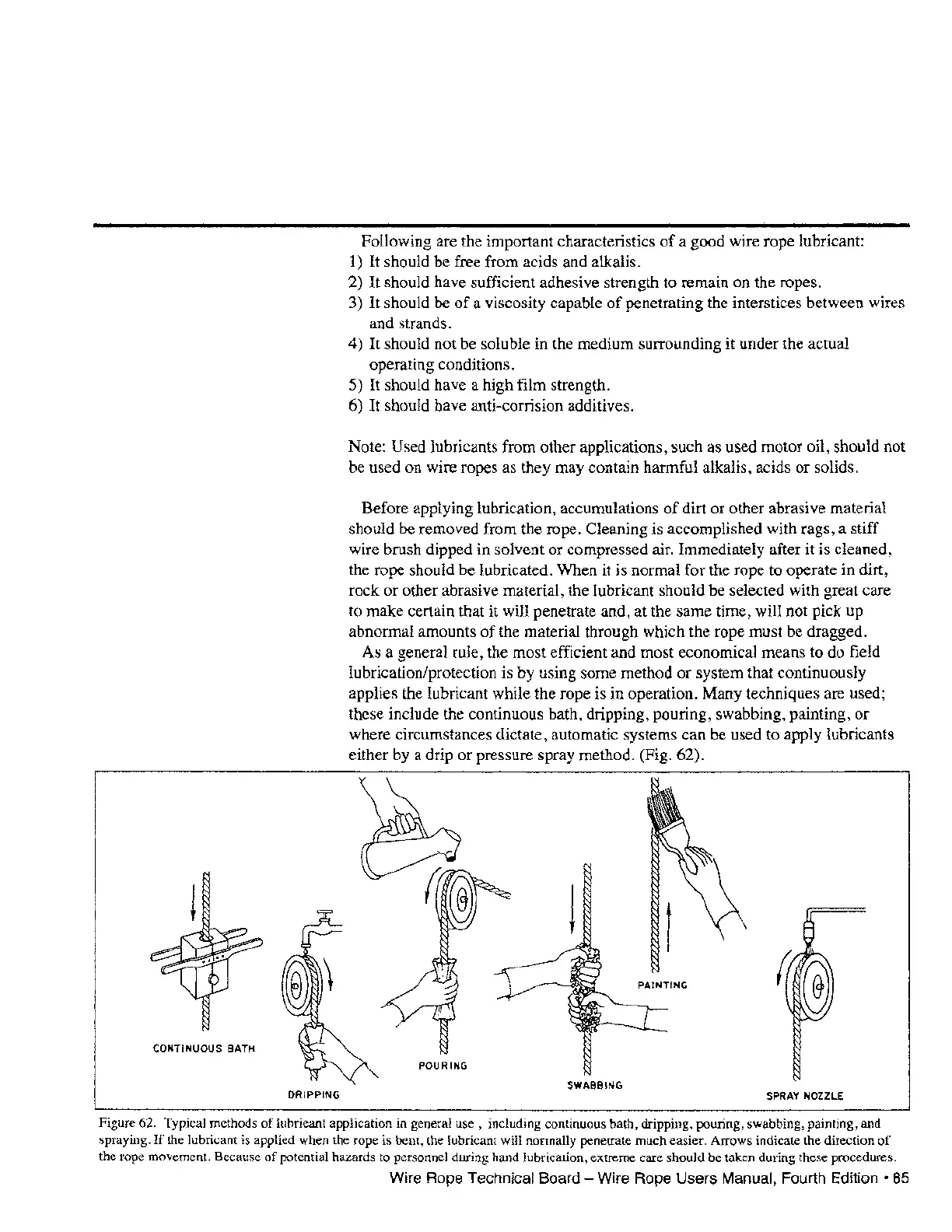
CONTINUOUS BATH
DRIPPING
Following are the important characteristics
of
a good wire rope lubricant:
1)
It
should be free from acids and alkalis.
2)
It
should have sufficient adhesive strength to remain on the ropes.
3)
It
should be
of
a viscosity capable
of
penetrating the interstices between wires
and strands.
4)
It
should not be soluble in the medium surrounding it under the actual
operating conditions.
5) It should have a high film strength.
6) It should have anti-corrision additives.
Note: Used lubricants from other applications, such as used motor oil, should not
be used on wire ropes as they may contain harmful alkalis, acids or solids.
Before applying lubrication, accumulations
of
dirt or other abrasive material
should be removed from the rope. Cleaning is accomplished with rags, a stiff
wire brush dipped in solvent
or
compressed air. Immediately after it is cleaned,
the rope should be lubricated. When it is normal for the rope to operate in dirt,
rock or other abrasive material, the lubricant should be selected with great care
to make certain that it will penetrate and, at the same time, will not pick up
abnormal amounts
of
the material through which the rope must be dragged.
As a general rule, the most efficient and most economical means to do field
lubrication/protection is
by
using some method
or
system that continuously
applies the lubricant while the rope is in operation. Many techniques are used;
these include the continuous bath, dripping, pouring, swabbing, painting,
or
where circumstances dictate, automatic systems can be used to apply lubricants
either
by
a drip or pressure spray method. (Fig. 62).
POURING
SWABBING
SPRAY
NOZZLE
Figure 62. Typical methods
of
lubricant application in general
use,
including continuous bath, dripping, pouring, swabbing, painting, and
spraying.
If
the lubricant is applied when the rope is bent, the lubricant will normally penetrate much easier. Arrows indicate the direction
of
the rope movement. Because
of
potential hazards to personnel during hand lubrication, extreme care should be taken during these procedures.
Wire Rope Technical Board - Wire Rope Users Manual, Fourth
Edition·
85



 To Next Page