A. ONE-PART LINE
WIRE
ROPE
EFFICIENCY
WHEN
OPERATING
OVER
SHEAVES
(TACKLE
BLOCK
SYSTEM)
Some
portion of a wire rope's
strength-when
operating over
sheaves-is
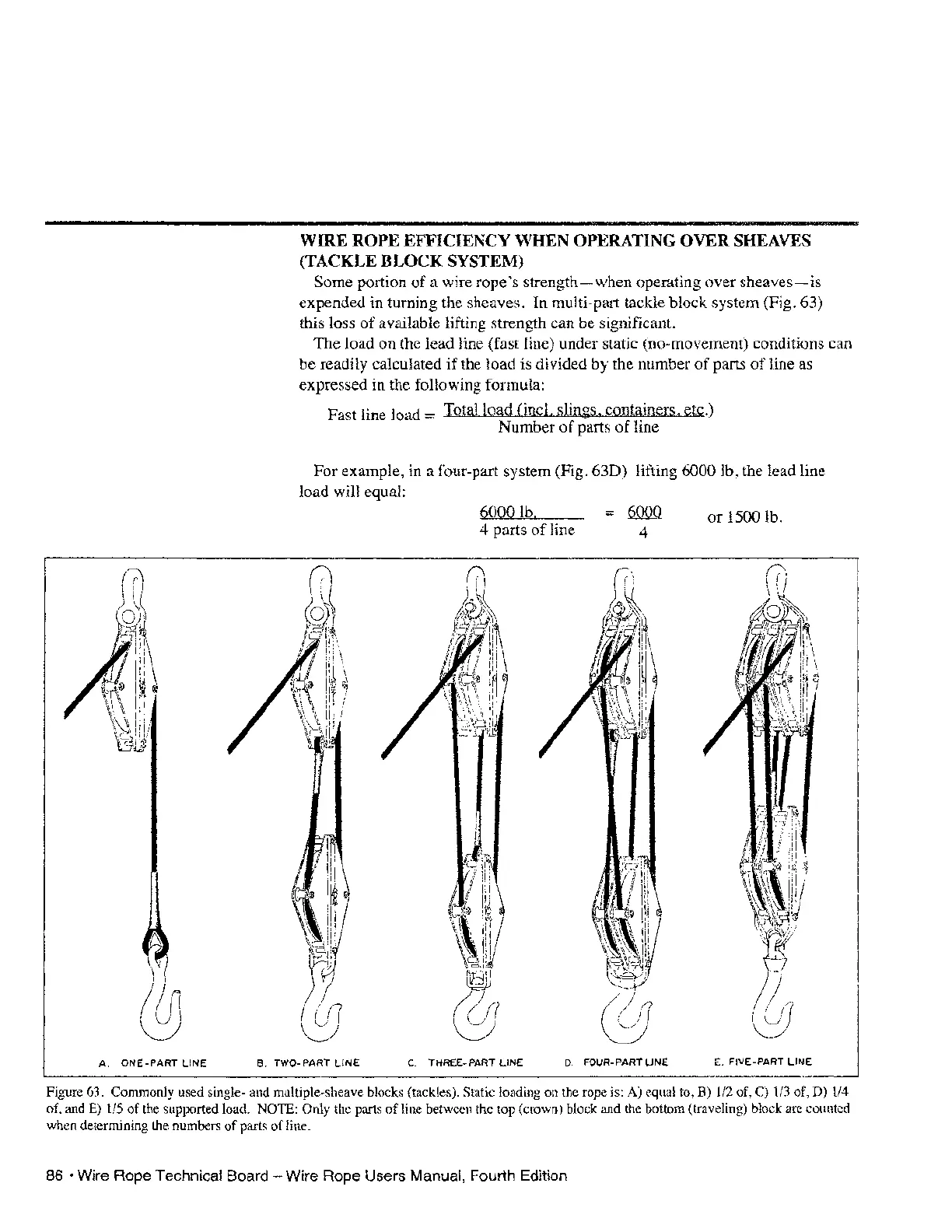
expended in turning the sheaves. In multi-pari tackle block system (Fig. 63)
this loss
of
available lifting strength can be significant.
The load on the lead line (fast line) under static (no-movement) conditions can
be
readily calculated
if
the load is divided by the number
of
parts
of
line as
expressed in the following formula:
Fast line load
= Total load (incl. slings. containers, etc.)
Number
of
parts
of
line
For example, in a four-part system (Fig. 63D) lifting
6000 lb, the lead line
load will equal:
8. TWO-PART LINE
6000 lb.
4 parts
of
line
=
.6!2QQ
4
C.
THREE-PART LINE
D.
FOUR-PARTLINE
or 1500 lb.
E.
FIVE-PART LINE
Figure 63. Commonly used single- and multiple-sheave blocks (tackles). Static loading on the rope is: A) equaJ to, B) 1/2 of, C)
113
of, D)
114
of. and E) 1/5
of
the supported load. NOTE: Only the parts
of
line between the top (crown) block and the bottom (traveling) block are counted
when determining the
numbers
of
parts
of
line.
86 • Wire Rope Technical Board - Wire Rope Users Manual, Fourth Edition


 To Next Page