On Outriggers Load Ratings:
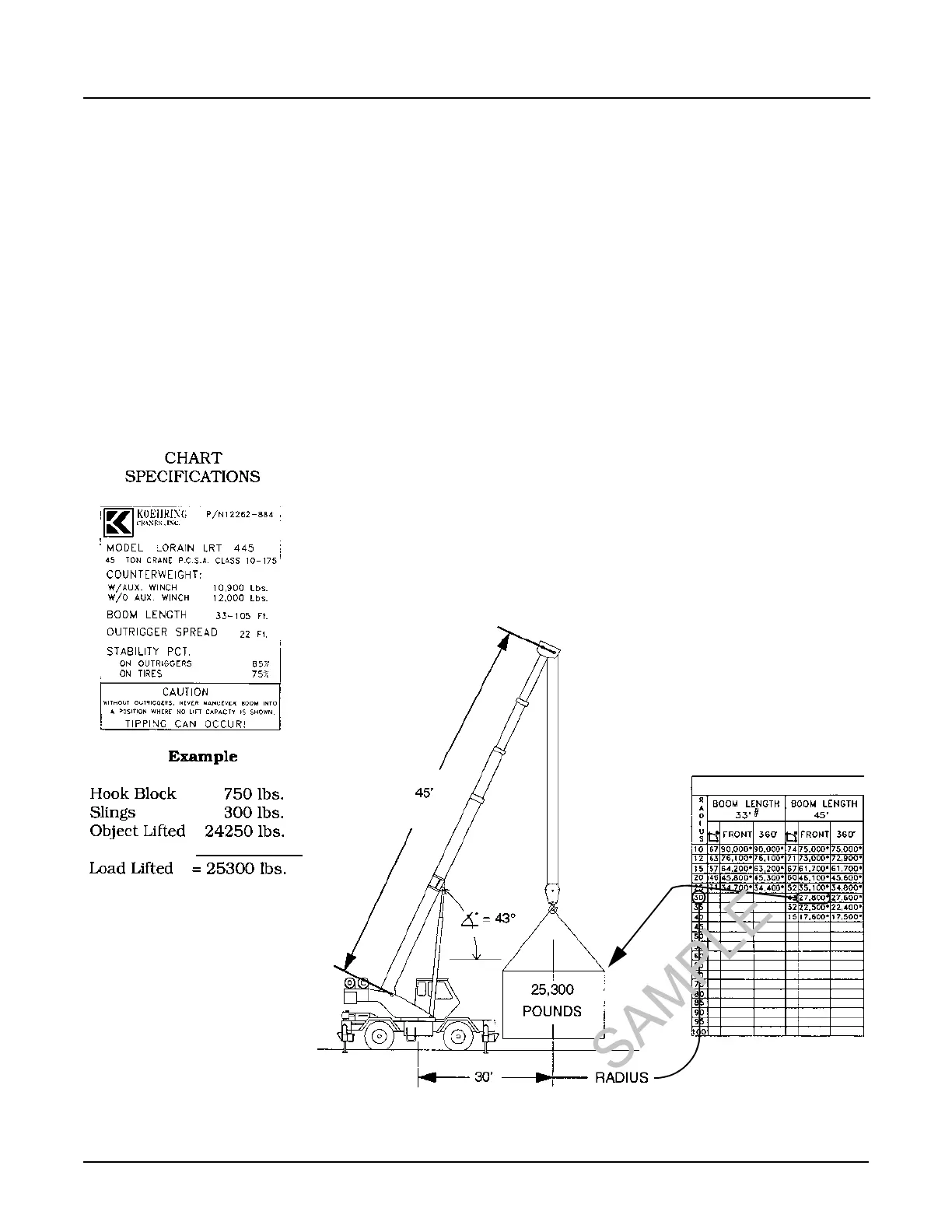
To determine the boom extension capacities with the
crane on outriggers, use the following procedure:
1. Determine weight of load to be lifted.
2. Determine weight of slings and rigging hardware.
3. Determine weight of hook block.
4. Determine other capacity deductions.
5. Calculate weight of lifted load.
6. Determine load radius, boom angle, and boom
length.
OPERATING PROCEDURES
7. Compare load weight with chart rated capacity for
the boom length, radius, and boom angle.
8. The lifted load must not exceed the chart rated ca-
pacity for the boom length and radius.
In this example, the lifted load of 25,300 lbs. is less
than the rated load of 27,800 lbs. and can be handled
as long as the machine is on outriggers per Notes 6 &
7, the load stays at 30 feet of radius or less, the condi-
tions of Note 18 are met and the machine is equipped
per Lift Chart specifications.
LOAD CHART NOTES
6. CRANE LOAD RATINGS ARE BASED ON THE CRANE BEING LEVELED
AND STANDING ON FIRM, UNIFORM SUPPORTING SURFACE.
7. CRANE LOAD RATINGS ON OUTRIGGERS ARE BASED ON ALL OUT-
RIGGER BEAMS FULLY EXTENDED AND THE TIRES RAISED FREE OF
THE SUPPORTING SURFACE.
18.PRACTICAL WORKING LOADS DEPEND ON THE SUPPORTING SUR-
FACE, WIND VELOCITY, PENDULUM ACTION, JERKING OR SUDDEN
STOPPING OF LOADS, HAZARDOUS SURROUNDINGS, EXPERIENCE
OF PERSONNEL AND PROPER OPERATION, TIRE INFLATION, TIRE
CONDITION, TRAVELING WITH LOADS, MULTIPLE CRANE LIFTS,
PROXIMITY OF ELECTRICAL WIRES, ETC. APPROPRIATE REDUC-
TION OF LOAD RATINGS MUST BE MADE FOR THESE AND ANY OTH-
ER CONDITIONS WHICH MAY AFFECT PRACTICAL WORKING LOADS.
Revised: October 20053 - 25RT700
S
A
M
P
L
E



 To Next Page