JIBS
To determine the jib capacities of the crane with all
boom lengths, use the following procedure:
1. Determine weight of load to be lifted.
2. Determine weight of slings and rigging hardware.
3. Determine weight of hook block.
4. Determine capacity deductions.
5. Calculate weight of lifted load.
6. Determine jib type and length, jib offset, main boom
angle.
7. Select correct jib load chart (stowaway or side-
stow).
8. Compare load weight with chart rated capacity for
the jib length, boom angle, and jib offset (if applica-
ble).
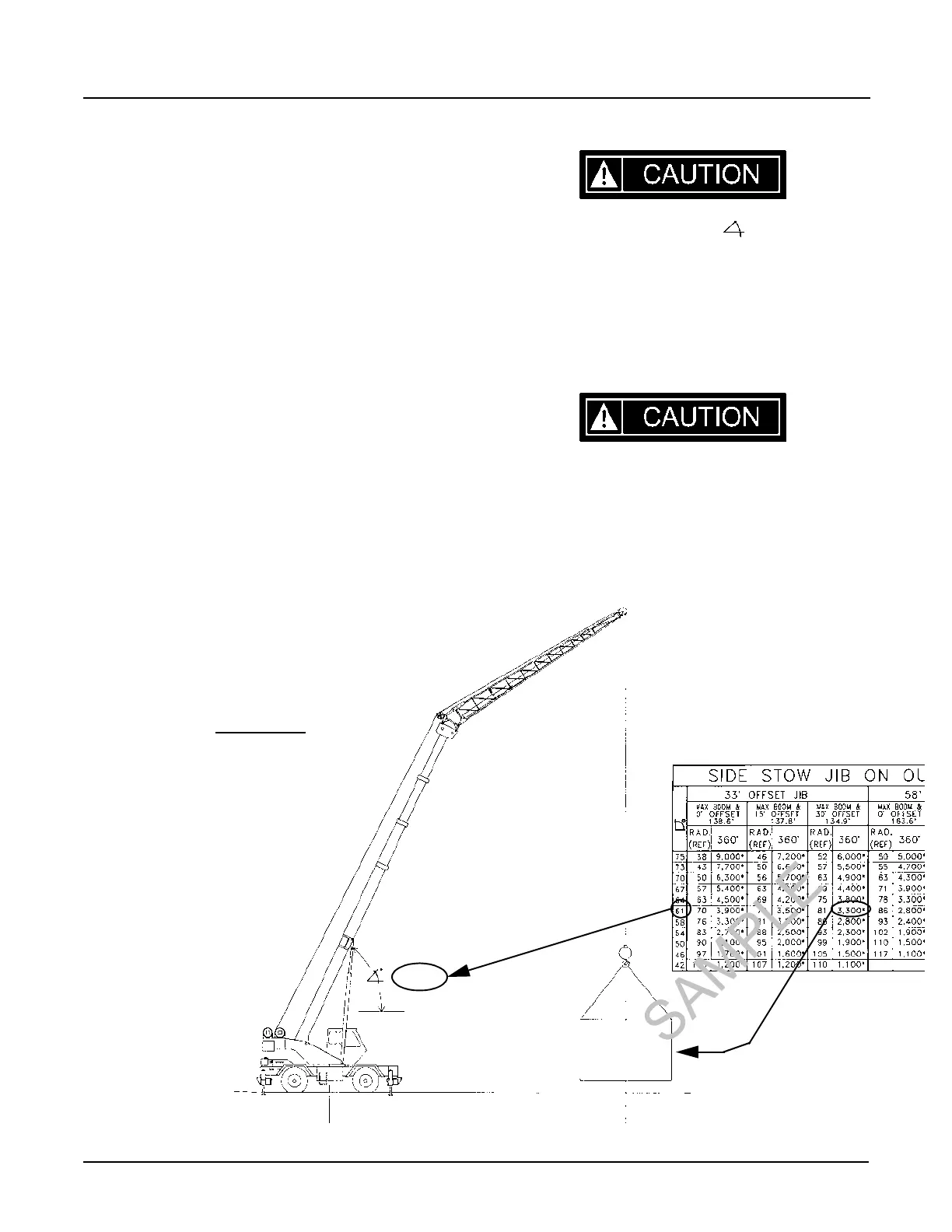
SIDE-STOW JIB
Jibs are rated by boom angle only and not by radius.
This means that as long as the boom is at 61° boom
angle and the jib at 30° offset, before loading, no mat-
ter if the boom is fully extended or retracted, it can only
lift a maximum of 3,300 lbs. on a 33 foot side-stow jib.
The radius shown in the jib chart is the expected radius
with a fully extended boom and jib after loading and de-
flection.
Never use a jib for clamshell or magnet operation. The
heavy side load due to swinging and bouncing that can
occur could damage jib or boom point. This is also true
of pick and carry operations.
Example
Hook & Ball 239 lbs.
Slings 300 lbs.
Object Lifted 2,500 lbs
Load Lifted = 3,039 lbs.
OPERATING PROCEDURES
In this example the total load lifted
is 3,039 lbs. The boom angle is
61°, the jib is at the 30°
offset and the machine is on out-
riggers. In this case the load can
be safly lifted.
3,039
POUNDS
= 61°
Revised: October 20053 - 26RT700
S
A
M
P
L
E


 To Next Page