EXAMPLE
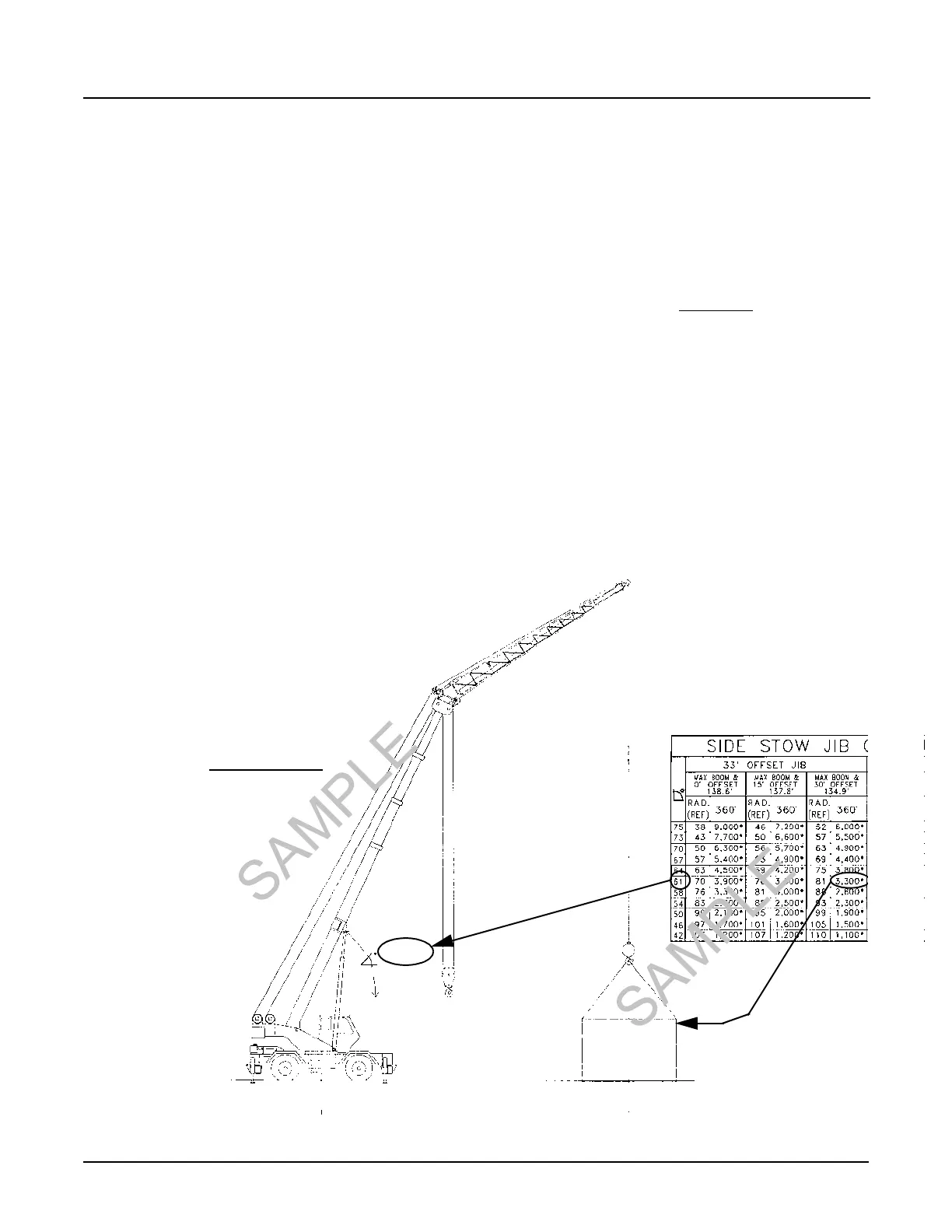
Hook & Ball 239 lbs.
Slings 300 lbs.
Auxiliary Head 110 lbs.
Hook Block 750 lbs.
Object 2,350 lbs.
Actual Load = 3,749 lbs.
3,749
POUNDS
= 61°
This lift cannot be made.
JIBS
To determine the jib capacities of the crane with all
boom lengths, use the following procedure:
1. Determine weight of load to be lifted.
2. Determine weight of slings and rigging hardware.
3. Determine weight of hook block.
4. Determine capacity deductions.
5. Calculate weight of lifted load.
6. Determine jib type and length, jib offset, main boom
angle.
7. Select correct jib load chart (stowaway or side-
stow).
8. Compare load weight with chart rated capacity for
the jib length, boom angle, and jib offset (if applica-
ble).
In the following example the crane is set up as follows:
1. On outriggers.
2. Side stow jib erected at 30° offset.
3. Auxiliary boom head sheave erected but not used.
4. Hook block off the main head but not used.
5. Boom angle of 61°.
At first glance it appears that the 2,350 lb. object to be
lifted is well within the capacity of the jib however after
making the deductions for the erected and unused
equipment and figuring the additional weight for slings
and the hook & ball this lift CANNOT be made.
Note: Deductions for erected but unused equipment
can either be deducted from the capacity OR added to
the weight to be lifted. In this case we will add the
weight to the load.
OPERATING PROCEDURES
Revised: October 20053 - 27RT700



 To Next Page