iCNC PERFORMANCE
6-2 MAINTENANCE / TROUBLESHOOTING Manual 0-5399
Direction of Cut
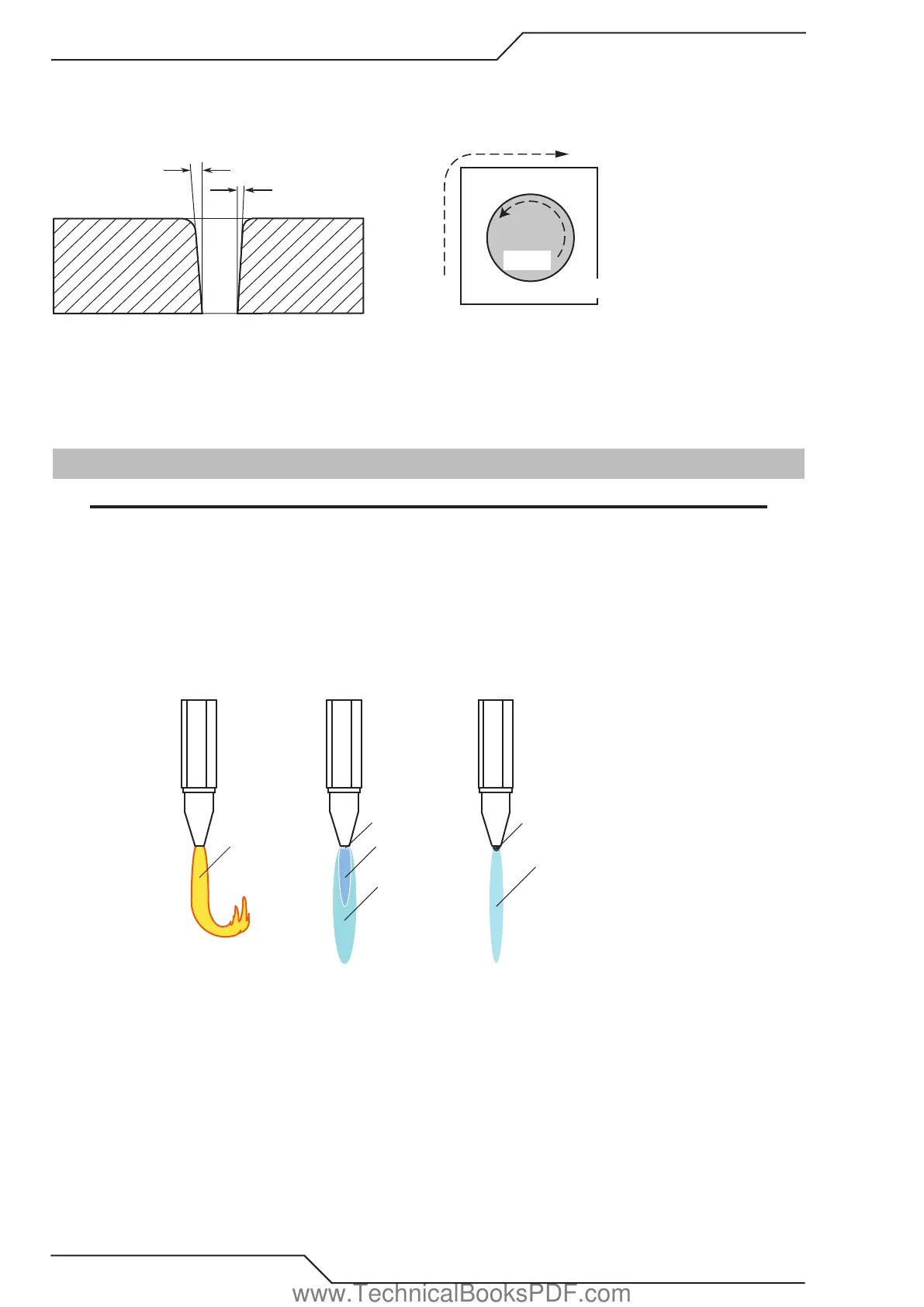
The plasma gas stream swirls as it leaves the torch to maintain a smooth column of gas. This swirl effect results in one side of a cut
being more square than the other. Viewed along the direction of travel, the right side of the cut is more square than the left.
Right Side
Cut Angle
Left Side
Cut Angle
A-00512
Scrap
Clockwise
Counter-
Clockwise
Art # A-04182
Workpiece
Scrap
Swirl Effect on Side Characteristics Of Cut
To make a square - edged cut along an inside diameter of a circle, the torch should move counterclockwise around the circle. To keep the
square edge along an outside diameter cut, the torch should travel in a clockwise direction.
6.3 Oxy fuel cutting quality
Note!
Always follow manufacturers guide lines on adjustments and cutting parameters.
6.3.1 Igniting and adjusting a neutral flame
1. Ignite the flame
2. Add gas until the flame separates from the tip and then slowly decrease the gas until the flame touches the tip again.
3. Slowly start to add oxygen and watch the inner cone, the blue inner cone will start to shorten as you increase the oxygen flow. Increase
the oxygen until the inner cone reduces to the same length as the small preheat flame.
4. At this point the flame temperature and intensity is at its maximum.
Flame ignited
no oxygen
Inner cone
Blue cone
oxygen added
Bluish flame
almost invisible
Bluish flame
almost invisible
Blue flame
same size as inner cone
6.3.2 Effect of preheat on cut quality
Characteristics of proper preheat:
1. Top edge is quite square, and less than 1/16-2” melt over (top rounding).
2. Face of the cut contains an easily removable thin layer of slag which covers a clean surface with well
defined drag lines from top to bottom.
3. Bottom edge contains little to no easily removable slag.
Characteristics of too much preheat:
1. Top edge contains heavy roll over and occasional protrusions.
2. Black heavily crusted slag will accumulate on the face of the cut, making it difficult to clean.
3. Upper portion of cut has little to no drag lines and lack of detail because of melting.
www.TechnicalBooksPDF.com



 To Next Page