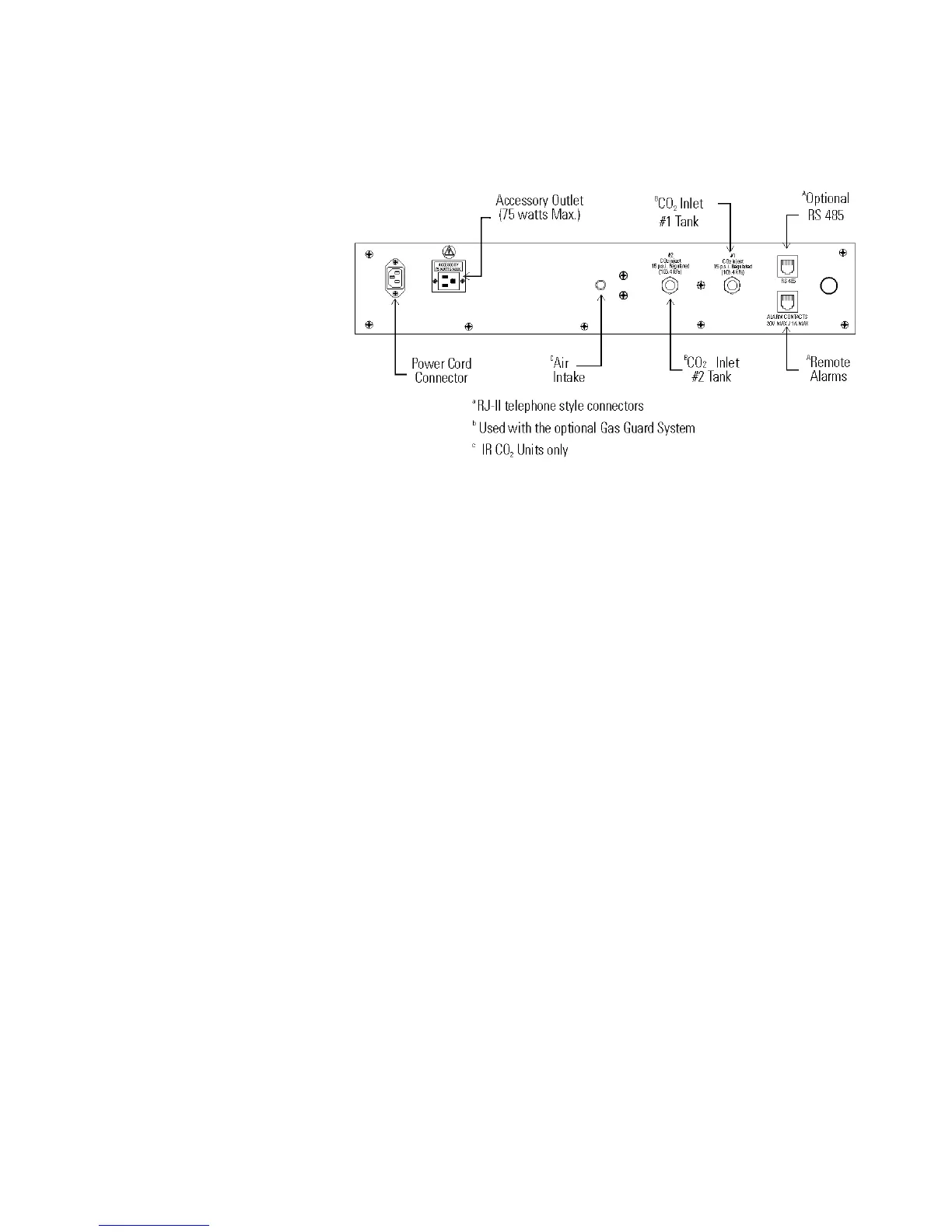
Plug the provided power cord into the power inlet connector on the back
of the cabinet (See Figure 1-11), then into the grounded, dedicated,
electrical circuit.
Figure 1-11. Connections on Unit Back
Fill the humidity pan with sterile pure water to within 1/2” of the top.
Place the pan directly in the center of the incubator floor to ensure best
humidity and temperature response.
For applications requiring abnormally high humidity, the pan should be
placed against the left side wall of the incubator. The ductwork has been
modified to allow the pan to be placed against the wall of the incubator.
In some ambient conditions, this may cause condensation to form in the
chamber.
For best operation of the incubator, sterilized distilled, demineralized or
de-ionized water should be used in the humidity pan. Water purity should
be in the resistance range of 50K to 1M Ohm/cm, or a conductivity range
of 20.0 to 1.0 uS/cm. Refer to ASTM Standard D5391-93 or D4195-88
for measuring water purity.
Distillation systems, as well as some types of reverse osmosis water purity
systems, can produce water in the quality range specified. Tap water is not
recommended as it may contain chlorine, which can deteriorate the
stainless steel. Tap water may also have a high mineral content, which
would produce a build-up of scale in the pan. High purity or ultra pure
water is not recommended as it is an extremely aggressive solvent and will
deteriorate the stainless steel. High purity water has a resistance of above
1M to 18M Ohm. Even high purity water can contain bacteria and
organic contaminants. Water should always be sterilized or treated with a
decontaminant, safe for use with stainless steel as well as safe for the
product, prior to being introduced into the humidity pan.
Model 310 Series DH Incubator 1-9Thermo Scientific
Section 1
Installation and Start-Up
Filling the Humidity Pan
Connecting the Unit to
Electrical Power (cont.)



 To Next Page