TK 61753-2-MM-EN
81
Fuel Solenoid
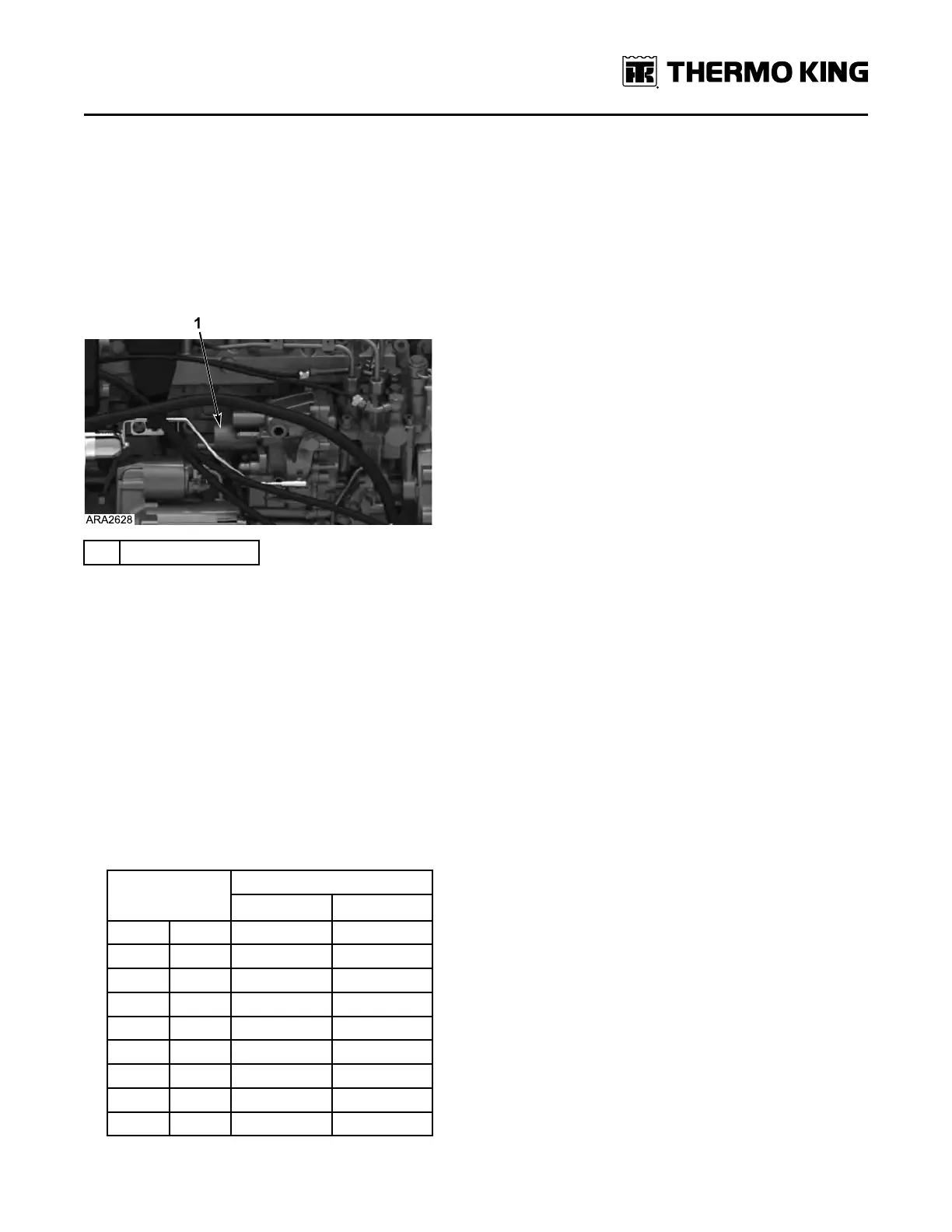
The fuel solenoid is located on the end of the injection pump. It contains two coils: the pull-in coil, and the hold-in coil.
The pull-in coil draws approximately 35 to 45 amps at 12 volts. The hold-in coil draws approximately 0.5 amps at 12
volts.
The pull-in coil must be energized to move the injection pump governor linkage to the fuel on position. Once the
injection pump governor linkage has been moved to the fuel on position, the hold-in coil will keep it in fuel on position
until the 8D circuit is de-energized. The pull-in coil must be de-energized after a few seconds to keep it from being
damaged. The pull-in coil is controlled by the microprocessor through the fuel solenoid pull in relay (K6).
Figure 35. Fuel Solenoid Location
1. Fuel Solenoid
Testing the Fuel Solenoid
If you suspect that the engine does not run because the fuel solenoid is not operating correctly, use the following
procedure:
1. Measure battery voltage.
a. With engine and controller off, check the voltage between the positive and negative battery terminals. If the
voltage is below 12.2 Vdc, the battery needs to be charged or replaced.
2. Remove the fuel solenoid from the engine and disconnect it from the wire harness.
3. Check the resistance of the hold-in coil.
a. Check the resistance of your meter leads first. Subtract these values from the resistance values you measure.
b. Check the hold-in coil resistance between pins A and C as shown (Figure 36, p. 82).
c. The resistance of the hold-in coil should be 22 to 27 ohms at 76 F (24 C).
NNoottee:: The resistance specifications above are for measurement at 76 F (24 C). If it is not possible to measure at
room temperature, use the following table as a guide for the expected resistance:
Temperature
Hold-In Coil Resistance
Low End High End
-25 F -32 C 17.3 Ohms 21.1 Ohms
-10 F -23 C 18.0 Ohms 22.0 Ohms
0 F -18 C 18.5 Ohms 22.6 Ohms
25 F -4 C 19.6 Ohms 24.0 Ohms
50 F 10 C 20.8 Ohms 25.4 Ohms
76 F 24 C 22.1 Ohms 27.0 Ohms
100 F 38 C 23.2 Ohms 28.3 Ohms
125 F 52 C 24.4 Ohms 29.8 Ohms
150 F 66 C
25.6 Ohms 31.2 Ohms
EEnnggiinnee MMaaiinntteennaannccee


 To Next Page