INTRODUCTION
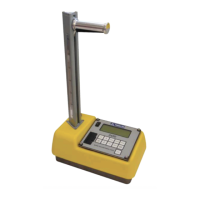
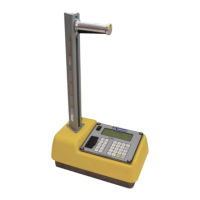
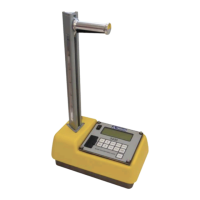
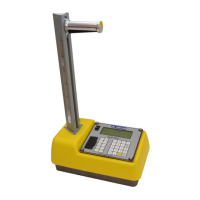
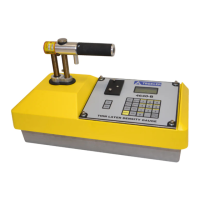
The Model 4640-B Thin Layer Density Gauge can quickly and
precisely determine the density of thin lift asphaltic concrete
overlays. The 4640-B determines the density of thin lift asphalt
overlays using backscatter gamma radiation technology. A patented
system with G-M detectors in the gauge base detects the gamma
radiation. A microprocessor converts the counts into a thin layer
density reading.
The gauge may be specially calibrated to accommodate many
different hot mix asphalt (HMA) mixes with variations in aggregate
size and type. The operator-selected depth of measurement assures
that the measurement is not influenced by underlying material.
Measurements may be obtained in as little as 60 seconds, and up to
750 readings may be stored for later use.
The nuclear method of testing asphalt density has been approved by
the American Society of Testing and Materials (ASTM) and the
Model 4640-B meets or exceeds all the requirements of ASTM
D-2950-91: Standard Test Method for Density of Bituminous
Concrete in Place by Nuclear Method.
Some information contained in this manual is used in training
courses offered by Troxler Electronic Laboratories, Inc., to assist
purchasers in obtaining a Radioactive Materials License from the
U.S. Nuclear Regulatory Commission (NRC) or an Agreement
State. Owners of this gauge must maintain a current radioactive
materials license as long as they own the gauge, even if it is in
storage and not actively being used.
Any licensing issues discussed in this manual are for the United
States. To purchase a Model 4640-B in Canada, owners must obtain
a radioisotope license from the Atomic Energy Control Board
(AECB). The owner should obtain copies of the AECB Regulations
and the Transportation of Dangerous Goods Act and Regulations.
This manual provides a guide to Canadian shipping requirements on
page D-11.
1–2




 To Next Page