4.7 Primary, secondary and per unit
scaling
VAMP 24h support phone +358 (0)20 753 3264
4.7. Primary, secondary and per unit
scaling
Many measurement values are shown as primary values
although the relay is connected to secondary signals. Some
measurement values are shown as relative values - per unit or
per cent. Almost all pick-up setting values are using relative
scaling. The scaling is done using the given CT and transformer
/ generator name plate values.
The following scaling equations are useful when doing
secondary testing.
4.7.1. Current scaling
NOTE! The rated value of the relay's current input, 5 A and 1A , does not have
any effect in the scaling equations, but it defines the measurement range
and the maximum allowed continuous current. See chapter 9.1.1 for
details.
Primary and secondary scaling
For residual currents to inputs I
01
or I
02
use the corresponding
CT
PRI
and CT
SEC
values. For earth fault stages using I
0Calc
signals use the phase current CT values for CT
PRI
and CT
SEC
.
Example 1: Secondary to primary.
CT = 500/5
Current to the relay's input is 4 A.
Primary current is I
PRI
= 4x500/5 = 400 A
Example 2: Primary to secondary.
CT = 500/5
The relay displays I
PRI
= 400 A
Injected current is I
SEC
= 400x5/500 = 4 A
Per unit [pu] scaling
For phase currents excluding ArcI> stage
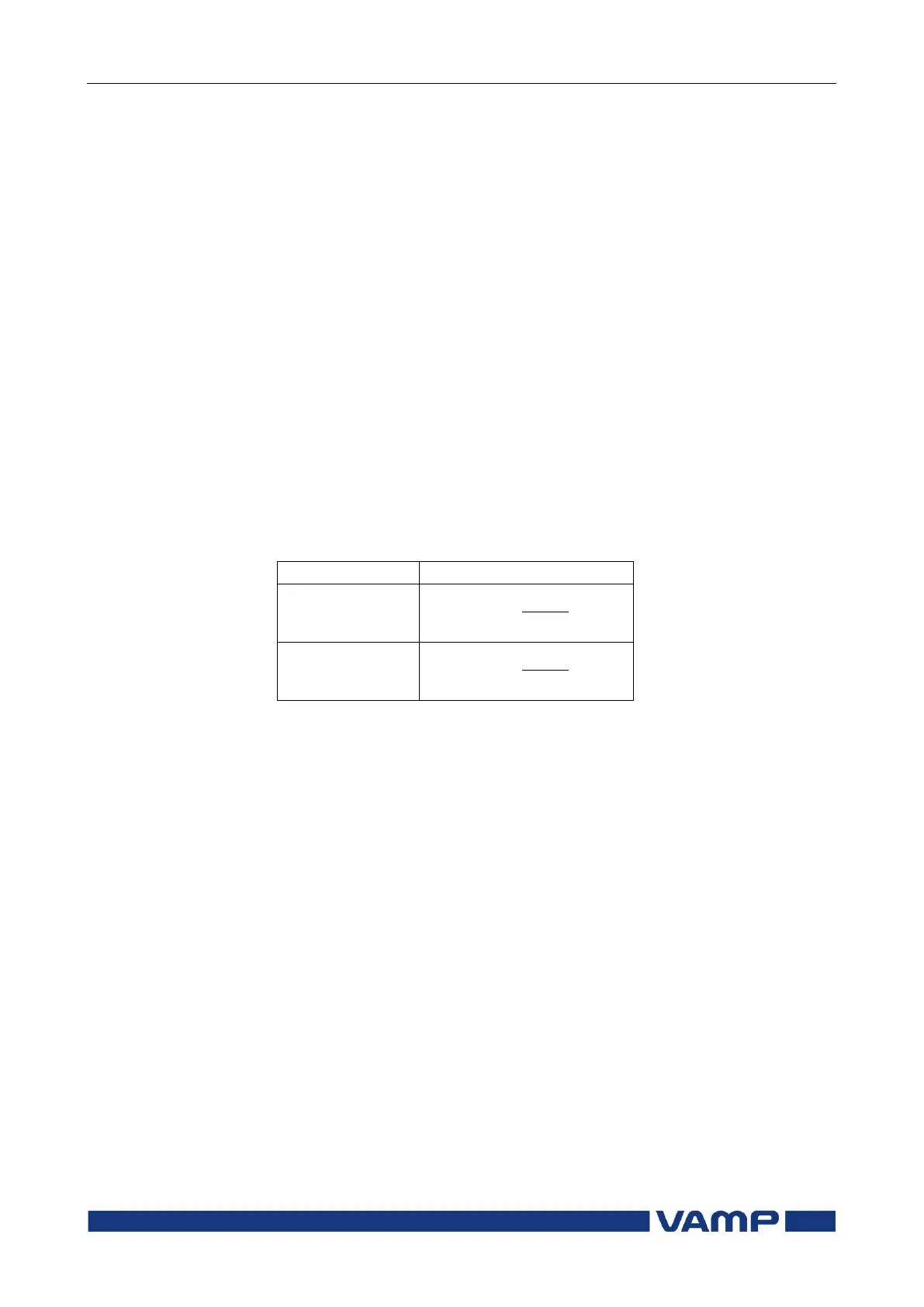
1 pu = 1xI
N
= 100 %, where
I
N
is the rated current of the transformer.
The rated current for high voltage side (HV) and low voltages
side (LV) are calculated by the device itself using Equation
4.7.1-1.


 To Next Page