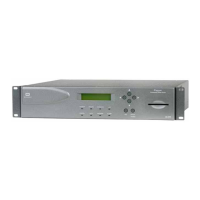
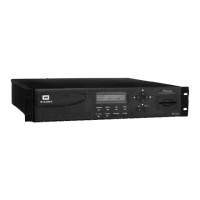
iPump User’s Manual
wegener.com 7 800009-01 Rev. A
ing. Up to 40 GB of storage (up to 43.3 hours of programming depending on
data rate) is available on standard iPumps and up to 240 GB on optional,
extended-storage iPumps (see Disk Storage Capacity).
Record and play functions can be used in such applications as "tape delay"/
time zone shifting, "spot" localization of commercials, and corporate training
media distribution.
Play Recorded Program File
The iPump plays out the selected, stored program files to the connected audio
and video monitors. File playing may be initiated by a predetermined schedule
via Compel or by a schedule stored internally to the iPump. The user may also
command playing of files directly from a web browser or from the front panel.
Two recorded programs (or one recorded and one live) may be played simulta-
neously on iPumps with an optional second decoder.
File Management
Compel users can rename or delete files stored on the iPump and organize
them into directories or folders. Renaming and deleting files may also be per-
formed through a web browser connected to the iPump over a LAN.
Playlists
Sequences of programs called Playlists can be created and stored on the iPump
by the user (locally or by COMPEL). Up to 100 Playlists can be stored in non-
volatile memory and played back with no interruption between programs. Set-
tings can be made to repeat the playlist indefinitely, complete the playlist and
repeat only the last program indefinitely, or complet the playlist and simply
return the decoder to its previous state.
Routing
The iPump can serve as a satellite-to-LAN IP router. Both unicast and multi-
cast IP traffic is supported. Multicast traffic can include, for example, MPEG
video streaming data. The IGMP protocol is followed for multicast traffic.
Stream Creation
The iPump can create IP multicast video streams and present them on the LAN
for use by other equipment. The source of the video stream may be either a pre-
recorded or downloaded file or a "classical" DVB program.



 To Next Page