44 2576780000/00/02-2018
Commissioning
Pulse value (addr. 102, 104)
The pulse value species how much energy (Wh or varh) should
correspond to a pulse.
The pulse value is determined by the maximum connected load
and the maximum number of pulses per hour.
If the pulse value is specied with a positive sign, pulses will only
be issued if the measured value also has a positive sign.
If the pulse value is specied with a negative sign, pulses will only
be issued if the measured value also has a negative sign.
Pulse value =
maximum connection power
maximum number of pulses per hour
Since the active energy meter works with a return
stop, pulses are only issued during import of electrical
energy.
Since the reactive energy meter works with a return
stop, pulses are only issued under inductive load.
Determining the pulse value
Setting the pulse length
Set the pulse length according to the requirements of the con-
nected pulse receiver.
For a pulse length of 30 ms, for example, the Energy
Meter 610/610-PB can issue a maximum number of 60,000 pulses
(see Table “Maximum Pulse Number”) per hour.
Determining the maximum connected load
Example:
Current transformer = 150/5 A
L-N voltage = max. 300 V
Power per phase = 150 A x 300 V
= 45 kW
Power for 3 phases = 45 kW x 3
Maximum connected load = 135 kW
Calculating the pulse value
Pulse value =
maximum connection power
maximum number of pulses per hour
Pulse value = 135 kW / 60000 pulses/h
Pulse value = 0.00225 kWh/pulses
Pulse value = 2.25 Wh/pulses
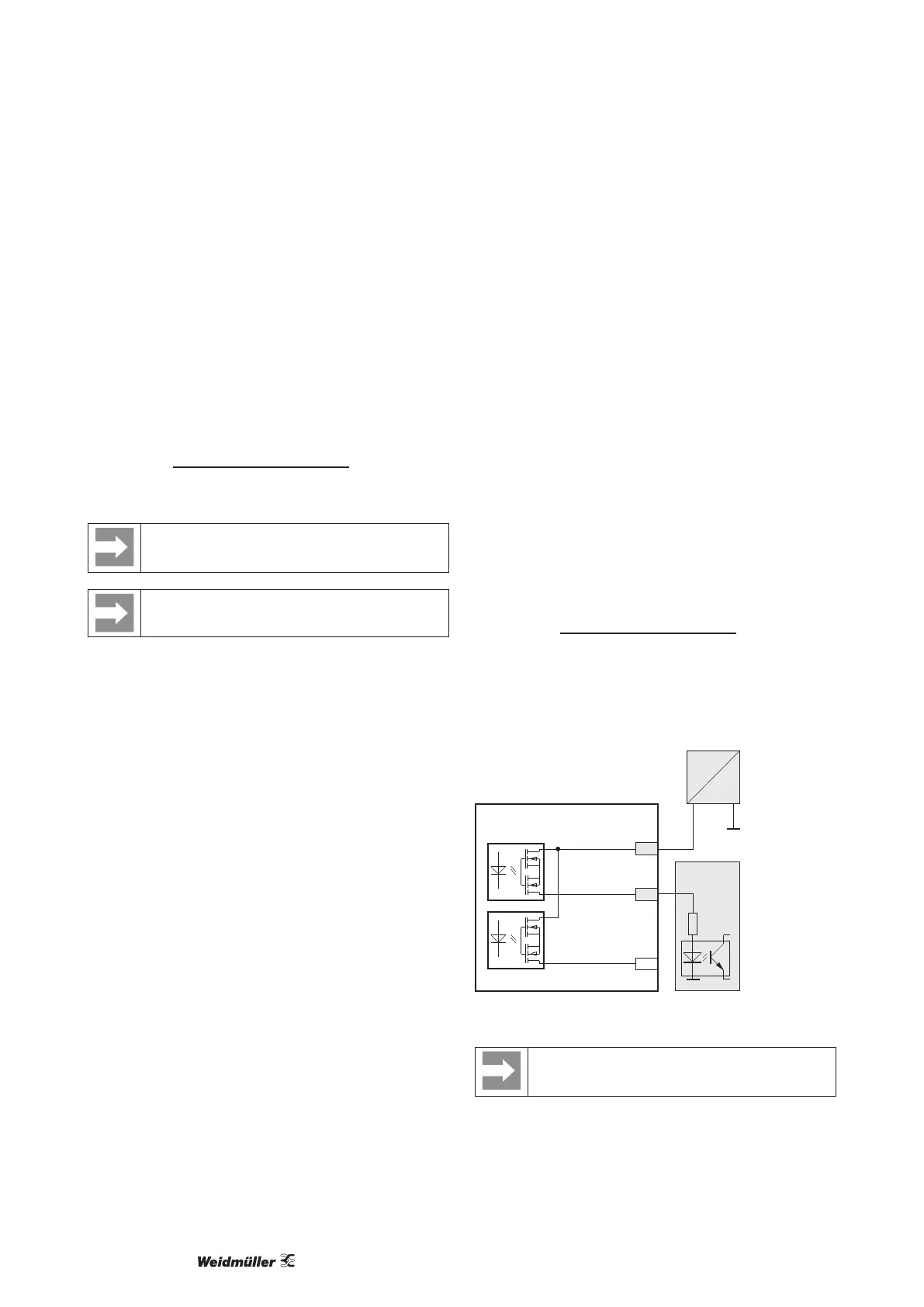
+ -
230 V AC
24 V DC
External
operating voltage
1.5 k
Data logger
Energy Meter 610/610-PB
Switching and pulse outputs
+24V=
13
14
15
Fig.: Connection example for wiring the pulse output.
When using the digital outputs as a pulse output, the
auxiliary voltage (DC) must only have a maximum
residual ripple of 5 %.


 To Next Page