Axiotech and Axiotech
vario
Carl Zeiss
B 40-020 e 06/99 3-7
3.3
Setting the microscope (basic settings)
The description of the steps required for the various illumination and contrasting techniques is based on
the following microscope settings:
• As described in chapter 2, the Axiotech or Axiotech
vario
microscope is ready for operation and switched
on as described in section 3.2.
• The pushrod (3-1/3), (3-2/3) or (3-3/3) to change the beam path is pushed in (subjective binocular
observation). Various reflector sliders now permit the fast change between the various illumination
and contrasting techniques.
3.4
Illumination and contrasting techniques
3.4.1
Setting of reflected-light brightfield for KÖHLER illumination
Reflected-light brightfield microscopy is the easiest
and most usual optical microscopy technique for
the examination of opaque samples or specimens,
e.g. polished material sections or wafers.
In addition to so-called direct beam bundles,
indirect bundles which are diffracted and scattered
at the specimen details, are of major importance
for an image as true to the object as possible. The
greater the portion of these indirect bundles
(aperture), the more the microscope image will be
true to the object, according to ABBE.
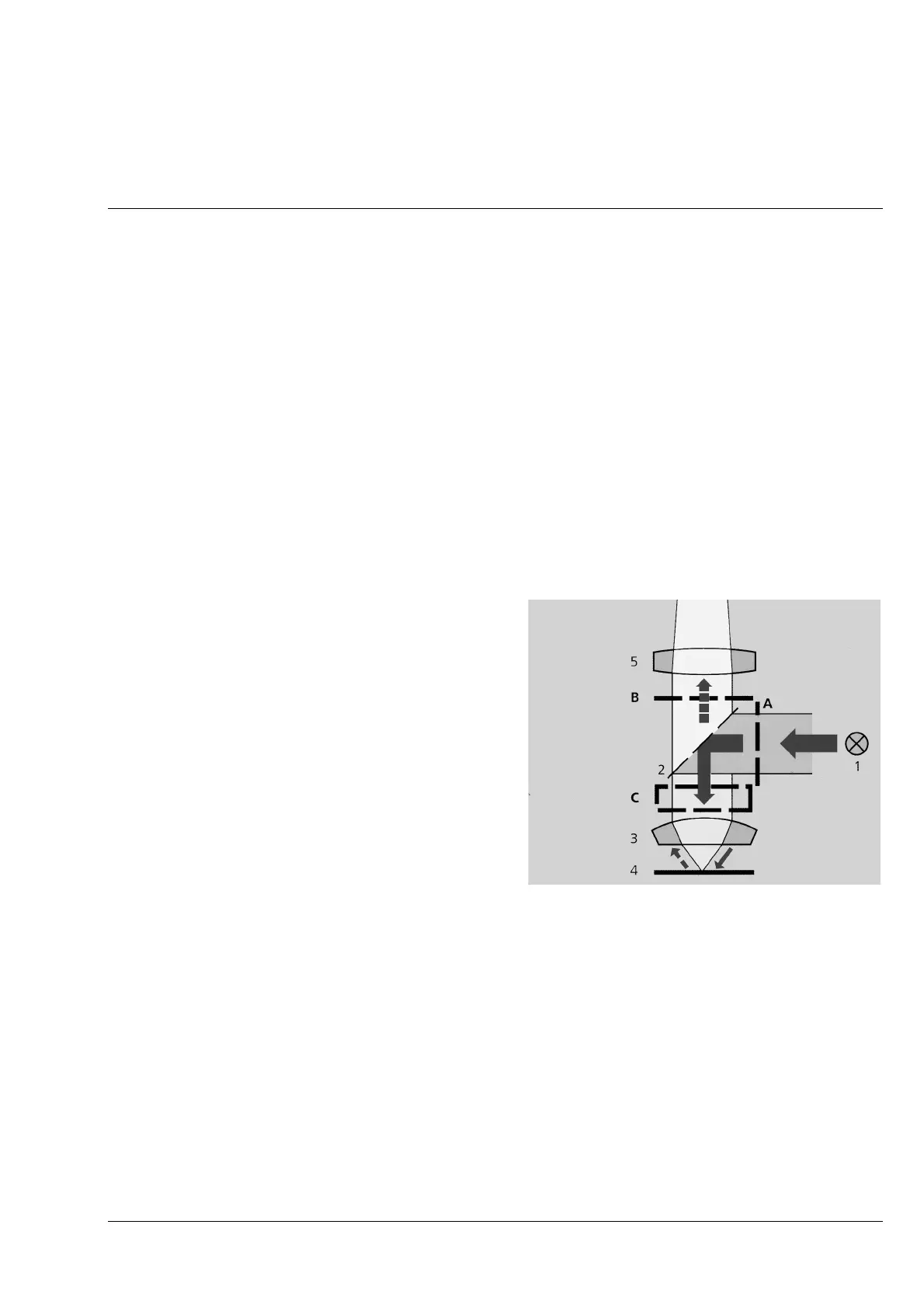
The bundled illumination light coming from a
reflected-light illuminator (3-6/1) is reflected from
a color-neutral beam splitter (3-6/ 2) and then
passes the objective (3-6/3) which focuses the
beams on the sample surface (3-6/ 4) (so-called
condenser function). The objective gathers the
reflected or indirect beam portions and – together
with the tube lens (3-6/ 5) – produces the
intermediary image which can then be viewed or
documented objectively.
To make use of the entire optical performance of
the microscope and the objective in particular, the luminous-field diaphragm and the aperture
diaphragm should be set in accordance with the regulations for KÖHLER illumination. These regulations
for the setting of the microscope are described below in detail.
Fig. 3-6 Reflected-light brightfield
illumination



 To Next Page