MAX_Kurzanleitung_Brief_Overview_V1.03_de_en 81 / 105
27.5.3 Transport instructions
27.5.4 Structure, function, operation
Three operating modes are available when operating the mobile workstation with lithium-ion technology:
Mode 1: operation (normal operation)
Mode 2: charging
Mode 3: operation and charging
27.5.4.1 Mode 1: Operation
You can use the mobile workstation to connect consumers to a secure 24 V DC (direct current) (option) or
230 V AC (alternating current) power source and to transport them. The 24 V DC power is generated by a
DC/DC converter and provided by a socket on the rear of the electronics box. If a DC/AC converter is
installed, the 12 V DC (direct current) is converted into a 230 V AC/50 Hz sinusoidal alternating current.
The lithium-ion battery is to be transported in an upright position in the original packaging or
equivalent. Never lift the lithium-ion battery by the two connection cables, but always use the side
handles. The battery has been tested in compliance with the UN manual of Tests and Criteria, Part
III, Sub-section 38.3 (ST/SG/AC.10/11 Version 5).
For transport as single battery, the battery belongs to category UN3480, Class 9, Packaging Group
II; during transport these regulations must be observed.
In the event of the complete mobile workstation being shipped, the mobile workstation with the
integrated lithium-ions battery belongs to the UN3481 category; during transport these regulations
must be observed.
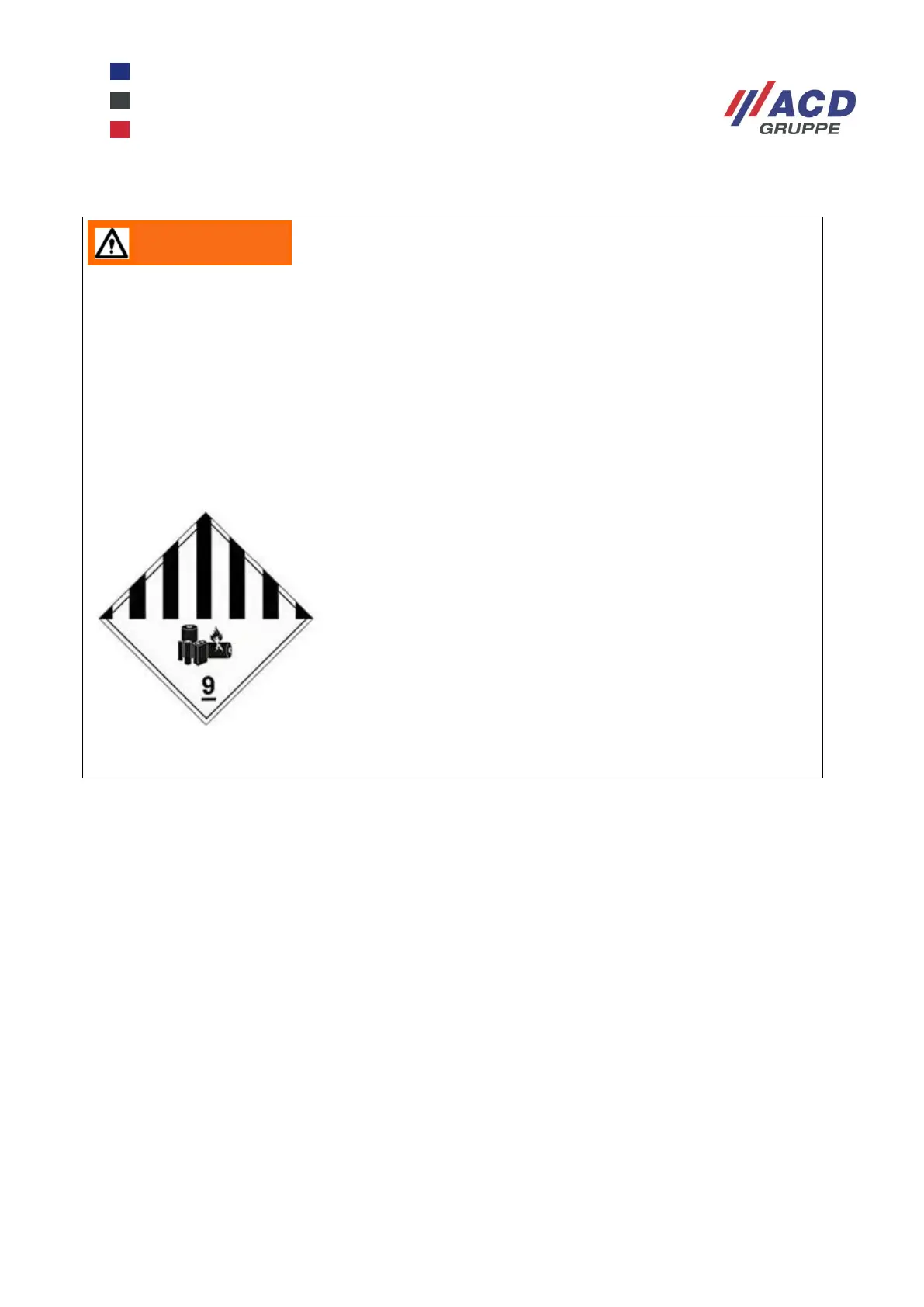
In both cases, the package must be affixed with an externally clearly visible hazardous goods
label, 100 x 100 mm, suitable for lithium-ion Class 9 batteries
Hazardous goods label Class 9


 To Next Page