EasyManua.ls Logo

ACT apricot - Page 153

ACT apricot
328 pages
Print Icon
To Next Page IconTo Next Page
To Previous Page IconTo Previous Page
Loading...
SERIAL INTERFACE
Mode Select (D2, D3).
The
combination
of
these
two
bits
differen
tia
te
between
asynchronous
and
synchronous
modes of operation
and
also specify
the
number
of stop bits
added
to
the
transmit
data
in
the
asynchronous mode.
The
receiver
circuits
always
check
for
one
stop
bit
in
the
receive
data, regardless of
the
number
of stop
bits
in
the
transmit
data.
Sync Mode (D4, D5).
If
synchronous
mode
is selected by
the
Mode Select bits,
these
bits
determine
the
type of
synchronous mode, for
transmit
and
receive data.
Clock
Rate (D6, D7).
These
bits specify
the
multiplier
applied to
both
the
transmit
and receiver
input
clock rate
prior to being
used
to
set
the
transmit
and
receive baud
rates. For
synchronous
modes
the
xl
clock
rate
must
be
selected.
Any
rate
may
be selected for
the
asynchronous
mode, apart from
the
xl
rate.
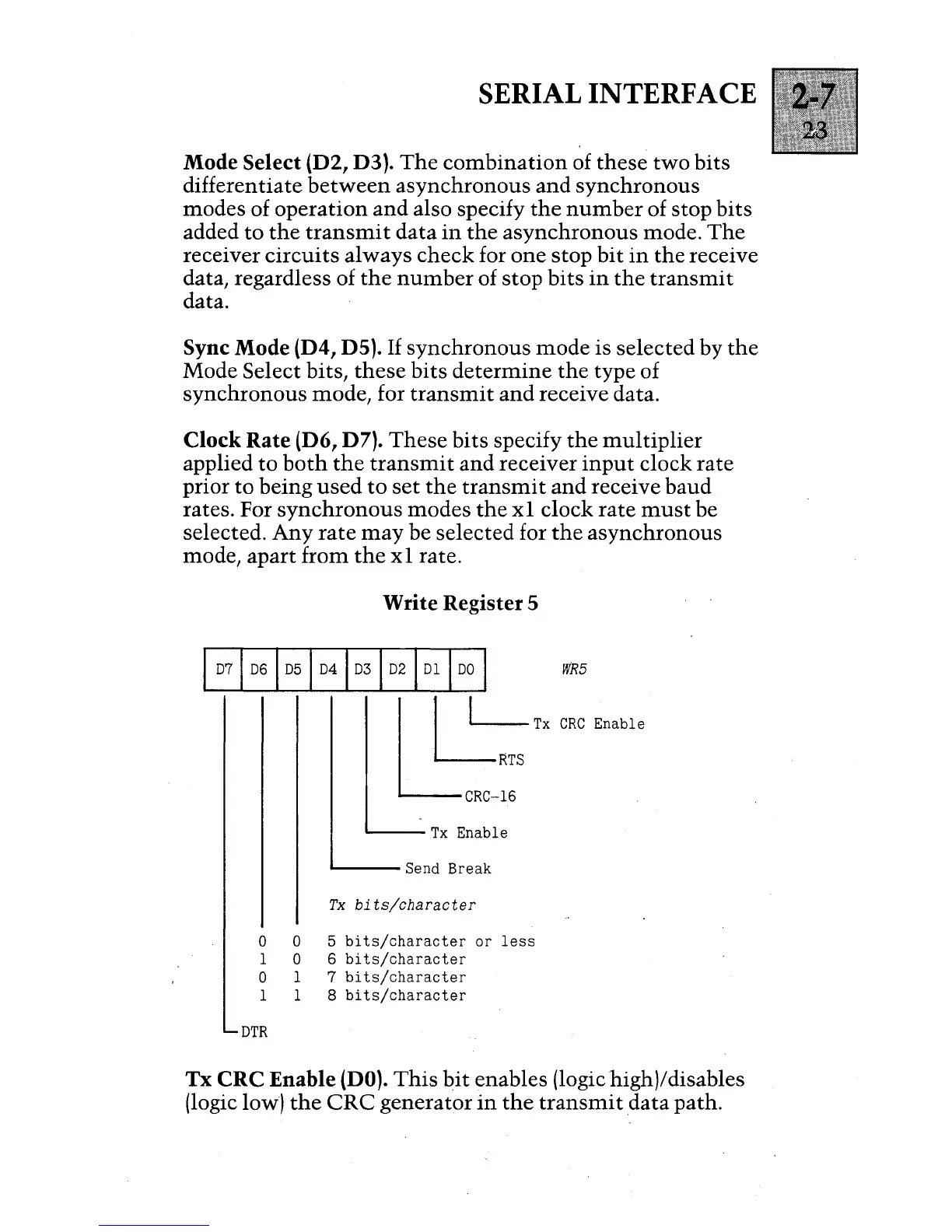
Write Register 5
1
D71
D61
D51
D41
D31
D21
Dl
1
DO
1
WR5
I I I
RTS
Tx
CRC
Enable
LCRC~16
'-----
Tx
Enable
""'-----
Send Break
Tx
bits/character
o 0 5
bits/character
or
less
1 0 6
bits/character
o 1 7
bits/character
1 1 8
bits/character
-DTR
Tx
CRC Enable
(DO).
This
bit
enables (logichigh)/disables
(logic low)
the
CRC
generator
in
the
transmit
data path.

Table of Contents

Other manuals for ACT apricot