EasyManua.ls Logo

ACT apricot - Page 175

ACT apricot
328 pages
Print Icon
To Next Page IconTo Next Page
To Previous Page IconTo Previous Page
Loading...
SERIAL INTERFACE
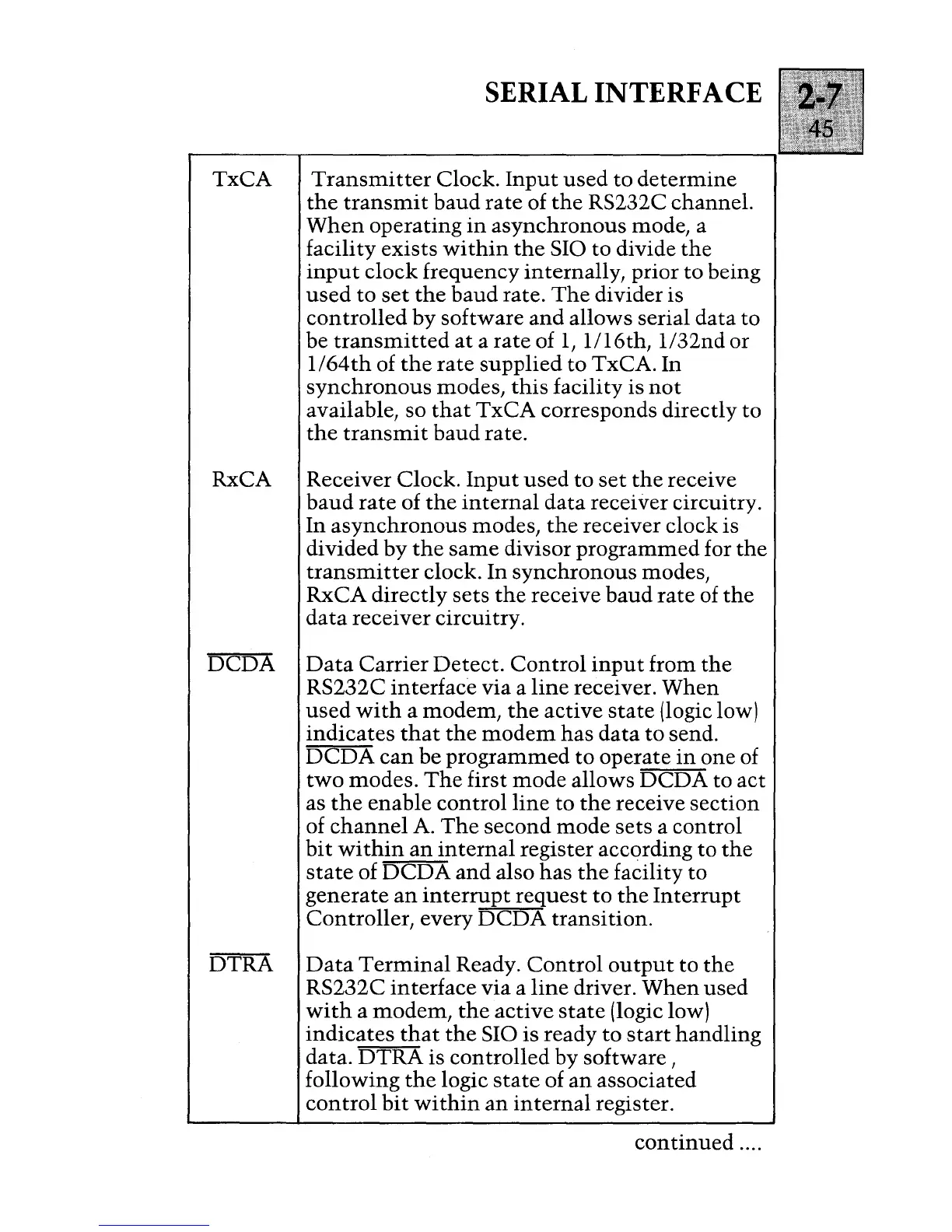
TxCA
Transmitter
Clock.
Input
used
to
determine
the
transmit
baud
rate
of
the
RS232C channel.
When
operating
in
asynchronous
mode, a
facility exists
within
the
SIO
to
divide
the
input
clock
frequency internally, prior
to
being
used
to
set
the
baud
rate.
The
divider is
controlled
by software
and
allows serial
data
to
be
transmitted
at
a
rate
of
1,
1/16th,
1/32nd
or
1I64th
of
the
rate
supplied
to
TxCA. In
synchronous
modes,
this
facility is
not
available, so
that
TxCA
corresponds directly
to
the
transmit
baud
rate.
RxCA Receiver Clock.
Input
used
to
set
the
receive
baud
rate
of
the
internal
data
receiver circuitry.
In
asynchronous
modes,
the
receiver clock is
divided by
the
same
divisor
programmed
for
the
transmitter
clock.
In
synchronous
modes,
RxCA
directly
sets
the
receive
baud
rate
of
the
data
receiver circuitry.
DCDA
Data
Carrier
Detect.
Control
input
from
the
RS232C interface via a
line
receiver.
When
used
with
a
modem,
the
active
state
(logic low)
indicates
that
the
modem
has
data
to
send.
DCDA
can
be
programmed
to
operate
in
one of
two
modes.
The
first
mode
allows
DCDA
to
act
as
the
enable
control
line
to
the
receive
section
of
channel
A.
The
second
mode
sets
a control
bit
within
an
internal
register according
to
the
state
of
DCDA
and
also
has
the
facility
to
generate
an
interrupt
request
to
the
Interrupt
Controller,
every
DCDA
transition.
DTRA
Data
Terminal
Ready.
Control
output
to
the
RS232C
interface
via
a
line
driver.
When
used
with
a
modem,
the
active
state
(logic low)
indicates
that
the
SIO is ready
to
start
handling
data.
DTRA
is controlled by
software,
following
the
logic
state
of
an
associated
control
bit
within
an
internal
register.
continued
....

Table of Contents

Other manuals for ACT apricot