EasyManua.ls Logo

ACT apricot - Page 176

ACT apricot
328 pages
Print Icon
To Next Page IconTo Next Page
To Previous Page IconTo Previous Page
Loading...
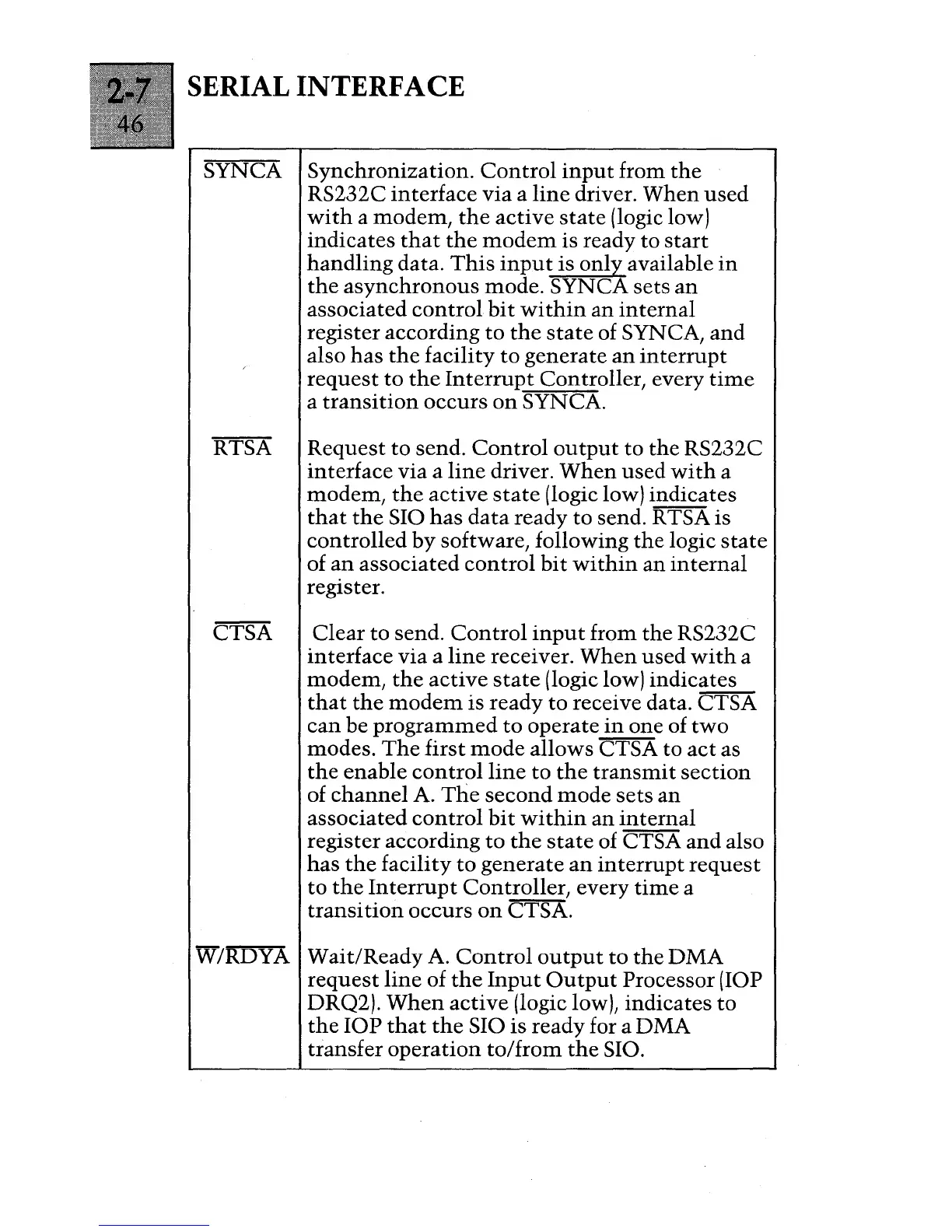
SERIAL INTERFACE
SYNCA Synchronization.
Control
input
from
the
RS232C
interface
via
a
line
driver.
When
used
with
a
modem,
the
active
state
(logic low)
indicates
that
the
modem
is ready
to
start
handling
data.
This
input
is
only
available
in
the
asynchronous
mode. SYNCA sets
an
associated
control
bit
within
an
internal
register according
to
the
state
of SYNCA,
and
also
has
the
facility
to
generate
an
interrupt
request
to
the
Interrupt
Controller, every
time
a
transition
occurs
on
SYNCA.
RTSA
Request
to
send.
Control
output
to
the
RS232C
interface via a
line
driver.
When
used
with
a
modem,
the
active
state
(logic low) indicates
that
the
SIO
has
data
ready
to
send. R TSA is
controlled
by software, following
the
logic
state
of
an
associated
control
bit
within
an
internal
register.
CTSA
Clear
to
send.
Control
input
from
the
RS232C
interface via a
line
receiver.
When
used
with
a
modem,
the
active
state
(logic low) indicates
that
the
modem
is ready
to
receive data. CTSA
can
be
programmed
to
operate
in
one of
two
modes.
The
first
mode
allows CTSA to
act
as
the
enable
control
line
to
the
transmit
section
of
channel
A.
The
second
mode
sets
an
associated
control
bit
within
an
internal
register according
to
the
state
of CTSA
and
also
has
the
facility
to
generate
an
interrupt
request
to
the
Interrupt
Controller, every
time
a
transition
occurs
on
CTSA.
W/RDYA
Wait/Ready
A.
Control
output
to
theDMA
request
line
of
the
Input
Output
Processor (lOP
DRQ2).
When
active
(logic low), indicates
to
the
lOP
that
the
SIO
is
ready for
aDMA
transfer
operation
to/from
the
SIO.

Table of Contents

Other manuals for ACT apricot