EasyManua.ls Logo

ACT apricot - Page 182

ACT apricot
328 pages
Print Icon
To Next Page IconTo Next Page
To Previous Page IconTo Previous Page
Loading...
PARALLEL
INTERFACE
The
constraints
of
the
various
hardware
inputs
and'
outputs
to
and
from
the
PIO
dictates
the
mode
and
direction
of operation of
the
three
ports. Port
A,
Port
B
and
the
4
most
significant
bits
(MSB)
of Port C are configured as
outputs
and
the
4
least
significant bits
(LSB)
of
Port
C are configured
as inputs,
to
provide
the
interface
with
a
printer
and
the
system
connections.
The
operating
mode
required is
the
basic
input/output
mode, defined as
Mode
o.
The
control
word
to
be
written
to
the
control
register
to
set
the
three
ports
into
the
required
operating configuration
is
thus
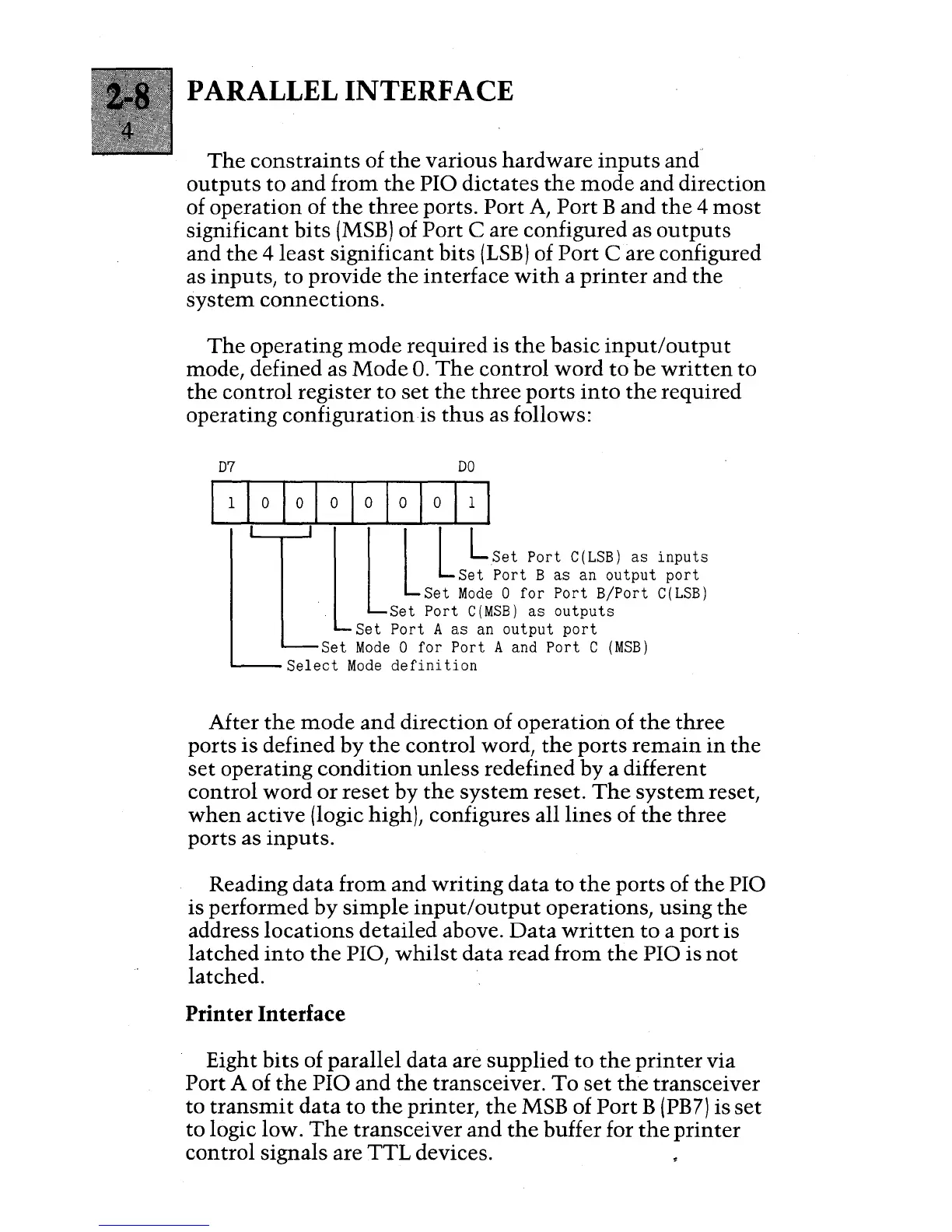
as follows:
D7
DO
11101010101010111
t
III
L
Lset
Port
C(LSB)
as
inputs
Set
Port B as an output
port
,
Set
Mode
0
for
Port
B/Port
C(LSB)
Set
Port
C(MSB)
as
outputs
Set
Port
A as
an
output
port
Set
Mode
0
for
Port
A and
Port
C
(MSB)
Select
Mode
definition
After
the
mode
and
direction
of
operation
of
the
three
ports
is
defined by
the
control
word,
the
ports
remain
in
the
set
operating
condition
unless
redefined by a different
control
word
or
reset
by
the
system
reset.
The
system
reset,
when
active (logic high), configures all
lines
of
the
three
ports as
inputs.
Reading
data
from
and
writing
data
to
the
ports
of
the
PIO
is performed
by
simple
input/output
operations, using
the
address
locations
detailed above.
Data
written
to
a
port
is
latched
into
the
PIO,
whilst
data
read
from
the
PIO is
not
latched.
Printer Interface
Eight
bits
of parallel
data
are supplied
to
the
printer
via
Port A of
the
PIO
and
the
transceiver.
To
set
the
transceiver
to
transmit
data
to
the
printer,
the
MSB of
Port
B
(PB7)
is
set
to
logic low.
The
transceiver
and
the
buffer for
the
printer
control signals are
TTL
devices.

Table of Contents

Other manuals for ACT apricot