EasyManua.ls Logo

ACT apricot - Page 181

ACT apricot
328 pages
Print Icon
To Next Page IconTo Next Page
To Previous Page IconTo Previous Page
Loading...
PARALLEL
INTERFACE
DESCRIPTION
General
The
Parallel Interface
consists
of; a programmable
parallel
input
output
port,
an
octal
bus
transceiver,
an
octal
buffer
and
a
Centronics
connector.
The
buffer forms
the
interface for
control
signals
between
the
board
and
the
printer,
and
the
transceiver forms
the
interface for data from
the
board
to
the
printer.
The
transceiver
(see Figure
1)
is bi-directional,
with
the
direction
of
data
flow
controlled
by
the
BIOS.
Whilst
used
as
a
printer
port,
the
flow of
data
is always
in
one direction
- only,
out
to
the
printer.
However
with
the
direction
capability of
the
transceiver,
the
port
can
be
more
generally
used
for transferring
data
to
and
from
the
Apricot.
The
three
input
control
signals, Fault,
Ack
and
Busy are
connected,
via
the
buffer,
to
input
lines
of
the
serial
interface
on
the
board (SIO).
The
three
inputs
are
used
to
generate
an
interrupt
to
the
CPU,
utilising
the
interrupt
capabilities of
the
SIO.
The
Intel
8255A-5 Parallel
Input
Output
Port
(PIO)
is
organized
internally
as
three
input/output
ports,
with
an
associated
control
register.
The
control
register
determines
the
direction
and
mode
of
operation
of
each
port.
The
system
software
views
the
three
ports
and
the
control
register as
an
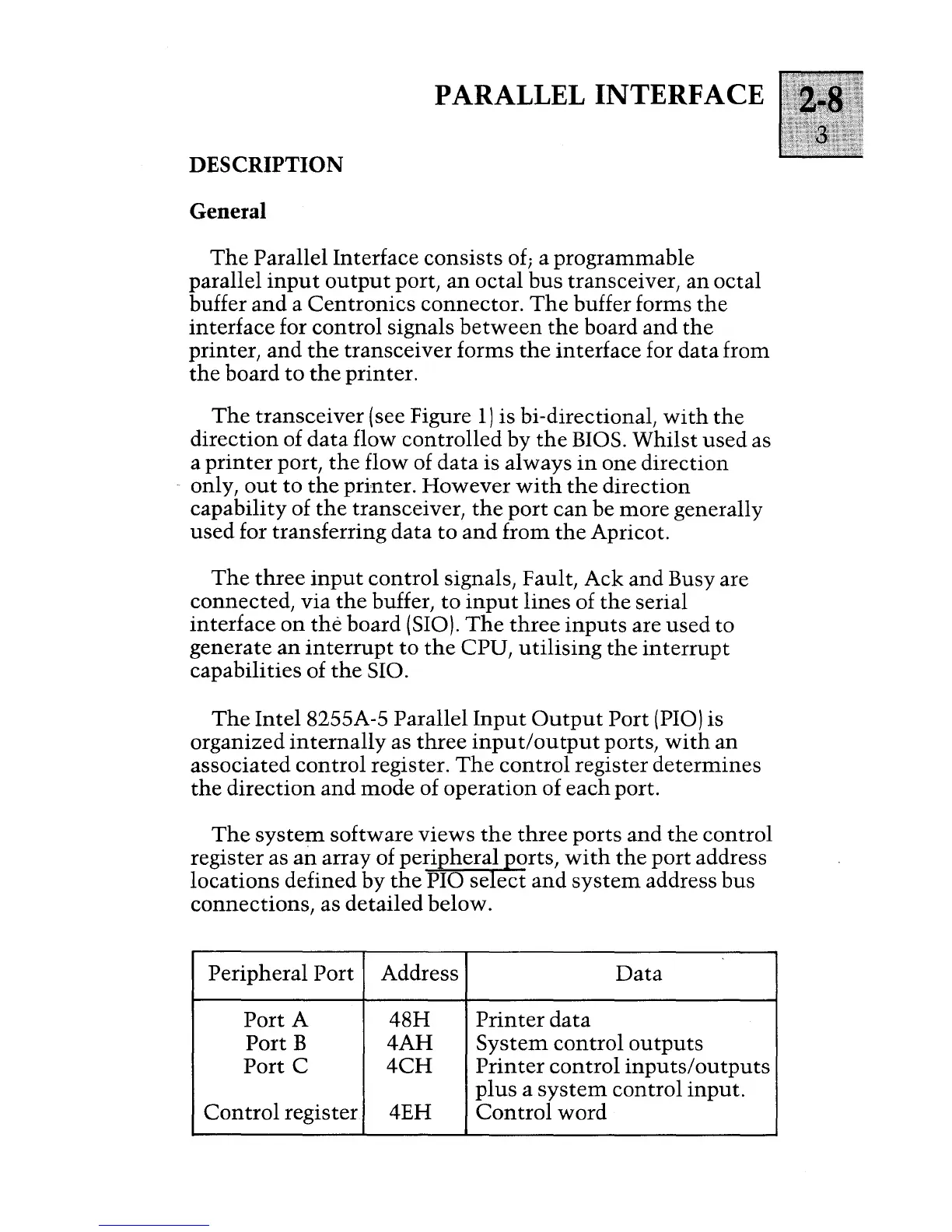
array of peripheral ports,
with
the
port
address
locations
defined by
the
PIO select
and
system
address bus
connections, as detailed below.
Peripheral Port Address
Data
Port
A
48H
Printer
data
Port
B
4AH
System
control
outputs
Port
C
4CH
Printer
control
inputs/outputs
plus
a
system
control
input.
Control
register 4EH
Control
word

Table of Contents

Other manuals for ACT apricot