EasyManua.ls Logo

ACT apricot - Page 64

ACT apricot
328 pages
Print Icon
To Next Page IconTo Next Page
To Previous Page IconTo Previous Page
Loading...
TIMER
The
count
state
is
decremented
on
the
negative edge of
each
0.25
MHz
clock pulse.
On
reaching zero
count
state,
the
counter
output
is
set
to
logic high.
Thi~
condition
remains
static
until
reset, (either by re-initializing
the
counter
or by loading a
new
value
into
the
counter).
The
counter
continues
to
decrement
after
the
zero
count
state
is
reached,starting from
the
maximum
count
state
of
the
counter,
until
reset. ( 2
16
for a binary counter, 10
4
for a BCD
counter).
This
feature allows
the
software
to
determine
the
exact
time
of
the
interrupt
request
by reading
the
Counter
0
count
state
and
performing a
simple
calculation.
CKOnnnJL
I I I
WRU
t
COUNT
$T.;1E
DUTO
C:OU~T
STATE
~
.
LATCliED
fROM
I
DATA
BUS
N I
N-l
I
COU~T
STATE
LOADED
tNT
u
COUN
r
lR
JLJlSl
I I I
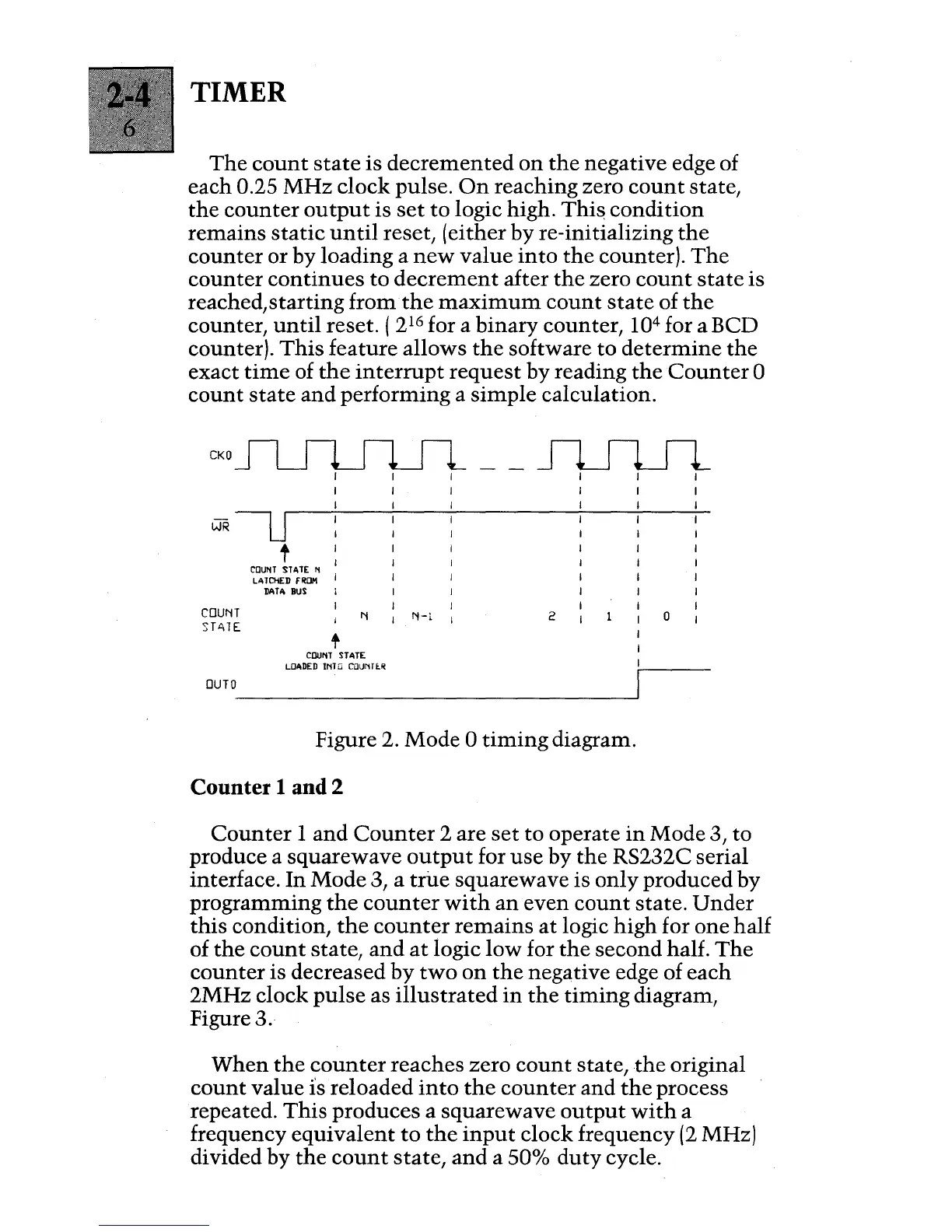
Figure 2. Mode 0
timing
diagram.
Counter 1 and 2
Counter
1
and
Counter
2 are
set
to operate
in
Mode 3, to
produce a squarewave
output
for
use
by
the
RS232C serial
interface.
In
Mode
3, a
true
squarewave is
only
produced by
programming
the
counter
with
an
even
count
state.
Under
this
condition,
the
counter
remains
at
logic
high
for one
half
of
the
count
state,
and
at
logic
low
for
the
second half.
The
counter
is decreased
by
two
on
the
negative edge of
each
2M
Hz
clock
pulse
as
illustrated
in
the
timing
diagram,
Figure 3.
When
the
counter
reaches zero
count
state,
the
original
count
value is reloaded
into
the
counter
and
the
process
repeated.
This
produces a squarewave
output
with
a
frequency
equivalent
to
the
input
clock frequency
(2
MHz)
divided by
the
count
state,
and
a
500/0
duty
cycle.

Table of Contents

Other manuals for ACT apricot