Page 12
2.3
Quick Start
Please install the drivers and the UP software prior to the
first use of FORTE.
2.3.1 Windows
Administrator rights are required to run the software
for the first time.
Start with installing the UP program. Its installer installs
the USB driver for FORTE, too. You can find the installer
on the supplied CD-ROM or on the web (the preferred
option).
Once the installation is complete, connect the FORTE
programmer to your computer.
The driver contained in the UP installer is intended for
Windows 7 and later. For older Windows operating system
versions the driver has to be downloaded from
www.asix.net, from download section of the programmer
and unpacked somewhere. After the programmer has
been connected, the operating system asks for the driver.
In "Found New Hardware" dialog the path to the
unpacked driver has to be set.
The green ON-LINE LED should turn on after a few
moments and the Windows Device Manager should
present the programmer as correctly installed.
2.3.2 Linux
The programmer can be operated under Wine in Linux.
Please find detailed installation instructions at separate
chapter.
2.4
Use
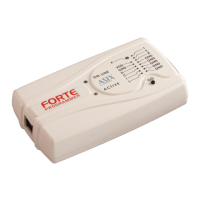
FORTE is a fast and flexible High-Speed USB programmer
suitable for programming of a range of devices such as
microcontrollers, EEPROM or Flash serial memory chips,
CPLD, FPGA and many others. It is equipped with
overcurrent protection at the VDD and VPP sources and
with overvoltage protection at the VDD pin.
The programmer is powered via USB. It can feed the
application to be programmed with a voltage of 1.8V to
5.5V or it can utilize an external application’s voltage
during programming.
The programmer may run under Windows XP or later or
under Linux in Wine.
Numerous Supported Devices
The list of supported devices includes:
• Microchip PIC microcontrollers – devices with serial
programming, which include all PIC and dsPIC devices
with the exception of several obsolete types.
• Microcontrollers with ARM core – such as ATSAM3N2A
or LPC2148.
• Atmel AVR microcontrollers – all devices supporting
"SPI Low Voltage Serial Downloading" such as
ATtiny12, AT90S8535 or ATmega128.
• Atmel ATxmega microcontrollers – devices
programmable via JTAG or PDI interface such as
ATxmega32D4 or ATxmega128B1.
• Atmel AVR32 microcontrollers – AT32UC3A1256, for
example.
• Atmel 8051 microcontrollers – devices that support
ISP programming such as AT89S8253, AT89LP4052,
AT89LP216 or AT89S2051.
• Texas Instruments microcontrollers – 16-bit MSP430,
CC430 and CCxxxx with a flash memory, including
their fuse programming.
• Cypress – PSoC microcontrollers.
• Serial EEPROM and Flash memory chips - I2C
(24LCxx), Microwire (93LCxx) and SPI (25Cxx).


 To Next Page