Page 84
integer
0 100kHz
1 400kHz
2 1MHz
3 Maximal
SpecSettings.FORTE.i2cAddr
integer
0 first suitable address or N/A
1 second suitable address
etc...
5.13
Appendix B: Use of ICSP
ICSP (In-Circuit Serial Programming) is a method of PIC
microcontroller programming making it possible to
program devices already placed on PCBs.
Two different algorithms may be used for PIC
microcontroller programming: HVP (using programming
voltage on pin -MCLR/VPP) or LVP (using the LVP pin).
The LVP programming algorithm can be disabled in the
device's configuration word. Microcontrollers have the
LVP algorithm enabled from the production, therefore
their PGM input needs to be treated during the first
programming (PGM input must be in log.0 for the time of
programming by means of the HVP algorithm).
Note: Not all devices have the PGM pin.
5.13.1 Pins Used for
Programming
This chapter describes how to treat pins in the ICSP
programming mode in accordance with the programming
algorithm.
HVP Algorithm
• PGM pin (if the device has one) must be maintained in
log.0!!
• -MCLR/VPP must be separated from the resetting
circuits (with a 10kΩ resistor, for example).
Aprogramming voltage is supplied to this pin P(VPP)
for programming. The leading edge and the voltage
level at VPP must not be influenced by the application.
The PRESTO programmer supports only fixed voltage
of 13V on pin P(VPP) in contrast to adjustable voltage
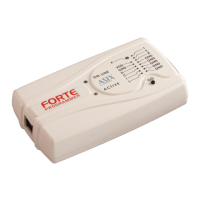
within a range of 6.5V to 17V supported by FORTE.
Please check limit voltage value on pin -MCLR/VPP of
the PIC device to be programmed by PRESTO.
• RB6 and RB7 pins must not be influenced by the
application during programming.
LVP algorithm (without VPP)
• RB6, RB7, PGM and -MCLR/VPP pins must not be
influenced by the application during programming. All
pins are in various logical levels during programming.
Loading of Different
Programmer Pins
The maximum current drawn from I/O pins, from pins
P(VPP) and VDD can be found in the Technical
Specification.
OTP (One-Time Programmable) devices have a
considerably higher current consumption on pin P(VPP)
than devices with a FLASH memory. Therefore the
application should not have any additional current
consumption at pin P(VPP) in case of OTP.
Data pins may have their signals changing at a speed of
several MHz, so the application must not influence the
signals in any significant way.


 To Next Page