Page 94
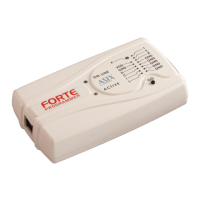
The maximum frequency is 3MHz for the PRESTO
programmer and 15MHz for FORTE.
If the Ignore FREQUENCY commands option is selected,
the programmer applies only the frequency set by the
user and ignores all FREQUENCY commands.
8.2.2 Fast Clocks Option
(FORTE only)
This option is available only for the FORTE programmer.
According to the JTAG specification, the signal at TDI is
sampled at TCK's rising edge. However, should a higher
frequency be required (around 5MHz or more), it may be
useful to change the moment of sampling from the rising
edge to the falling edge by shifting it by 1/2 of the TCK
period. To do so, choose Fast Clock Option.
8.2.3 RUNTEST without
run_count (SVF only)
The programmer should stay in the specified state for the
specified time and generate the clock signal on TCK while
executing an SVF file.
The specified time can be exceeded, but it slows the
programming process down. Even though it is not
supported by the SVF specification, many programmable
devices allow stopping the TCK clock during this time.
The programmer's ability to keep accurate time needs to
be considered. A high level of accuracy cannot be
achieved if the maximum frequency is used (the
programmer can guarantee respecting the min_time SEC
parameter only). A higher accuracy can be achieved with
slow clock (~100kHz). If the clock signal is not used at
all, the programmer is capable of following the min_time
SEC parameter almost exactly.
Three possibilities are available considering these facts:
• no clock on TCK
• slow clock on TCK (~100kHz)
• default speed clock on TCK
Example: "RUNTEST 3E-3SEC;" means "Generate clock on
TCK for at least 3ms".
8.2.4 RUNTEST Timing
Multiply (both SVF
and XSVF)
Recommended values:
• for accurate timing specified in the SVF or XSVF file:
0% (no added time)
• for XC9500(XL) family: 100% or more
• for Atmel AVR (e.g. ATmega128): 25%
8.2.5 RUNTEST with
run_count and no
timing
(bothSVFandXSVF)
This command should be interpreted as the minimum
frequency on TCK.
Yet some SVF file generators (such as Xilinx iMPACT, for
example) use this command as waiting time and assume
a frequency of 1MHz. For such cases the use of "interpret
as RUNTEST min_time with scale 1MHz" setting is
recommended.
JTAG Player Behavior When Reaching RUNTIME
Command With MINTIME Specification
(This concerns only SVF files as the RUNTEST alternative,
which is usable in XSVF XRUNTEST run_count cannot
specify time.)


 To Next Page